



When a government team starts designing a digital identity program, the reference cases arrive quickly and all at once: Estonia is held up as the model, India as the proof that it works at scale, the Nordics as the example of a system people actually use every day. All three are genuinely successful, and the useful observation is that they disagree with each other on nearly every design decision that matters.
That disagreement is the interesting part. Each country answered a different question first, and the answer to that first question determined everything downstream — who issues the identity, who operates the infrastructure, who pays for it, and what happens to a citizen who does not want to participate. Understanding which question each country answered first is far more useful than importing any one of them wholesale.
Estonia: the state issues, and the state runs the rails
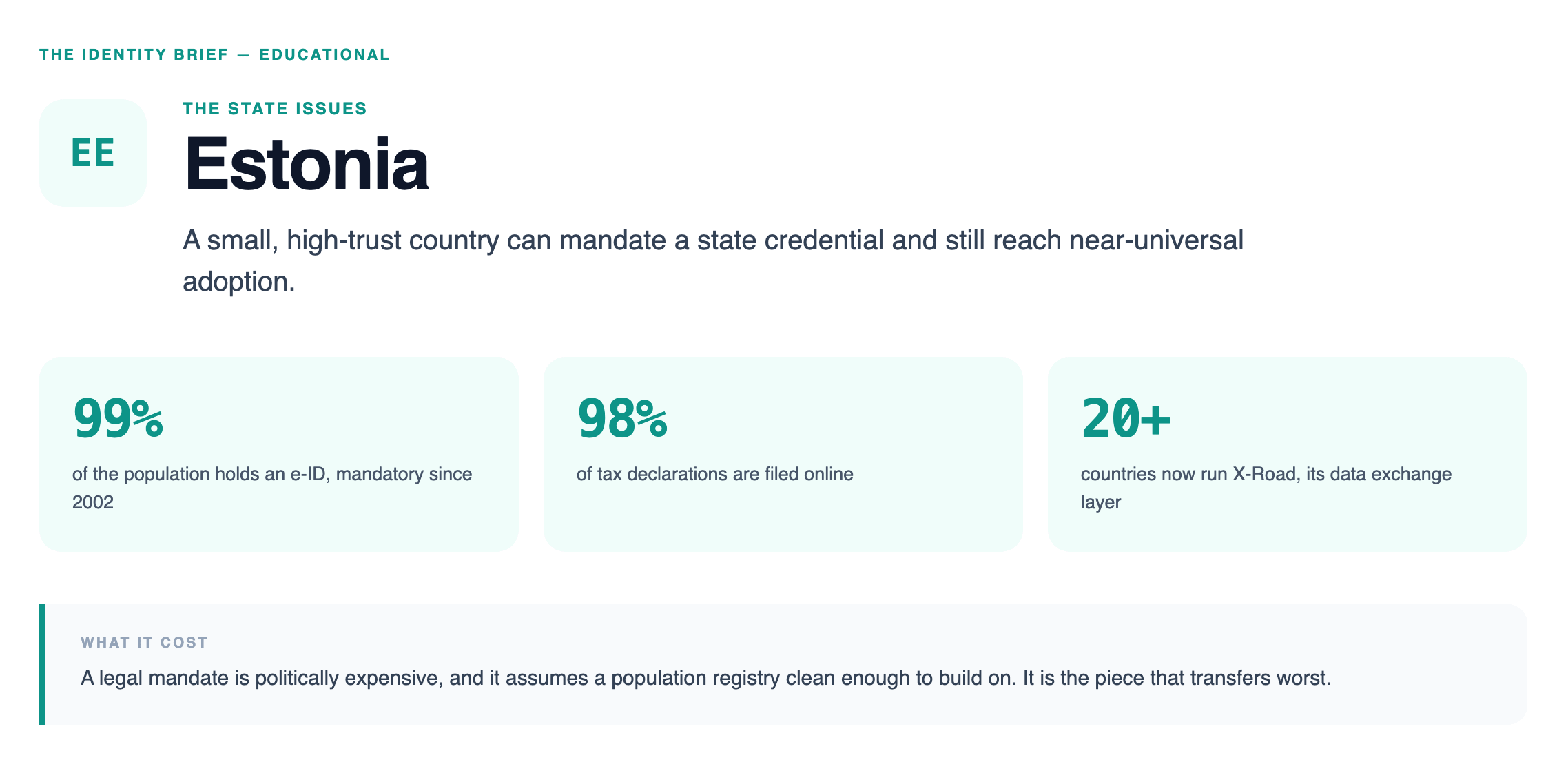
Estonia made identity a state obligation and built the exchange layer to match. The electronic ID card has been mandatory for citizens and residents since 2002, and roughly 99% of the population holds one. Around 90% of Estonians use e-services regularly, about 98% of tax declarations are filed online, and effectively the whole catalogue of public services is available around the clock.
The part that gets copied less often, and matters more, is X-Road — the data exchange layer that lets agencies query each other’s registries directly, with every request logged and attributable. It is what makes the once-only principle enforceable rather than aspirational: because the tax office can ask the population registry directly, nobody has to carry a certificate between counters. X-Road is now deployed in more than twenty countries, which makes it the single most portable component of the Estonian model.
The bet: that a small, high-trust country can mandate a state credential and get near-universal adoption without a fight.
What it cost: mandatory participation is politically expensive, and it is the piece that transfers worst. It also assumes a population registry clean enough to build on, which is a much larger precondition than it sounds.
The transferable lesson is architectural rather than political, and it is one we explored with Gustavo Giorgetti in our conversation on federalism as an interoperability advantage: what makes X-Road work is not that Estonia is centralized, but that the exchange layer carries institutional trust. Argentina’s provinces are building comparable ecosystems without a unitary state to impose them.
India: solve for scale first, layer the rest on top
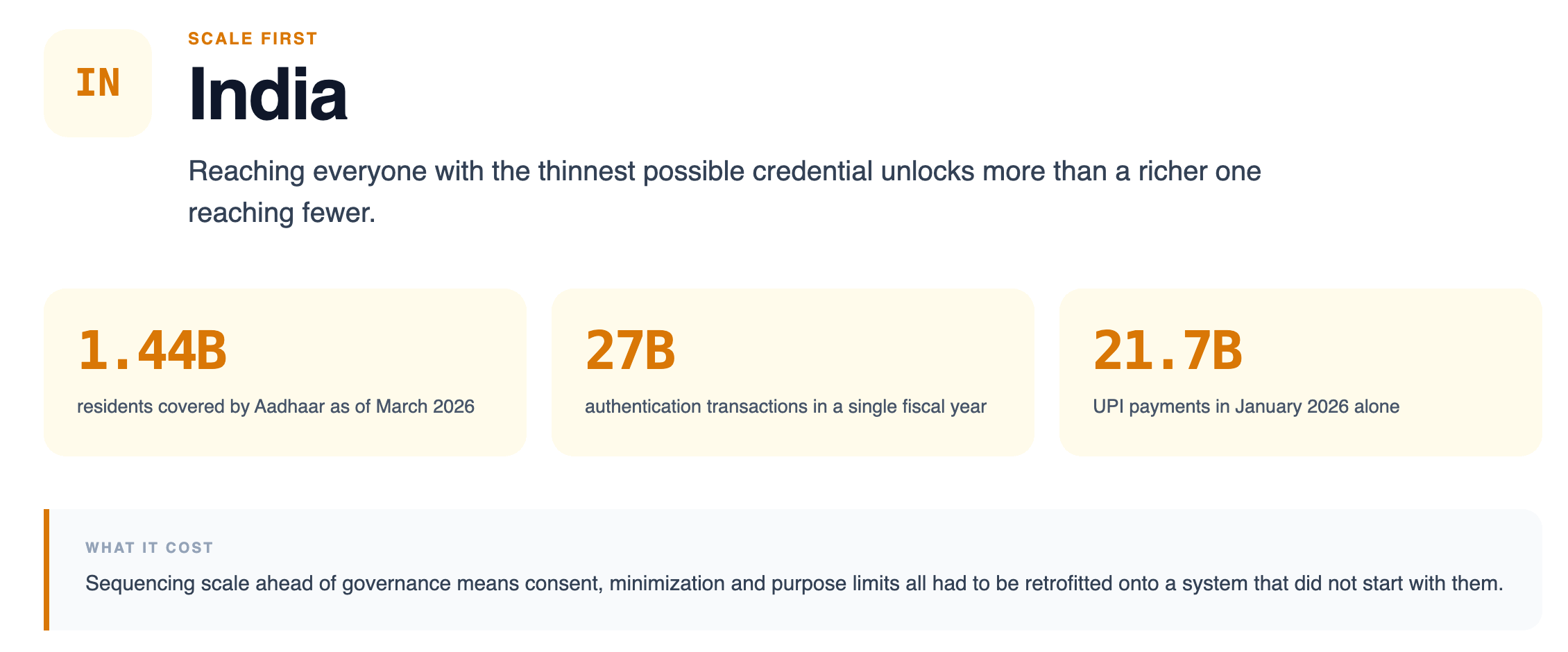
India inverted the order. Rather than start with a credential and a legal framework, it started with the largest possible base of unique, verifiable identity and treated everything else as a layer to be added afterward. Aadhaar now covers more than 1.44 billion residents, and authentication runs at a volume with no real precedent: over 27 billion authentication transactions in a single fiscal year.
That base became the floor for India Stack: payments (UPI, which processed 21.7 billion transactions in January 2026 alone), paperless document exchange (DigiLocker, eSign), and consented data sharing. The design principle is that identity is infrastructure rather than a product — a public rail that private services build on, which is precisely why the payments layer scaled the way it did.
The bet: that reaching everyone first, with the thinnest possible credential, unlocks more value than a richer credential that reaches fewer people.
What it cost: the privacy and exclusion debates that follow a centralized biometric database are real and ongoing, and much of the later architectural work has been about adding consent, minimization, and purpose limitation to a system that did not start with them. Sequencing scale ahead of governance means retrofitting governance.
The transferable lesson is the layering discipline: identity, payments, and data exchange as separate public rails that anyone can build on. Manuel Aguilera of the Centre for Digital Public Infrastructure made exactly this argument for the region in why Latin America should stop building alone — Brazil’s PIX is the clearest regional proof that the layered model travels.
Denmark: the banks were already there
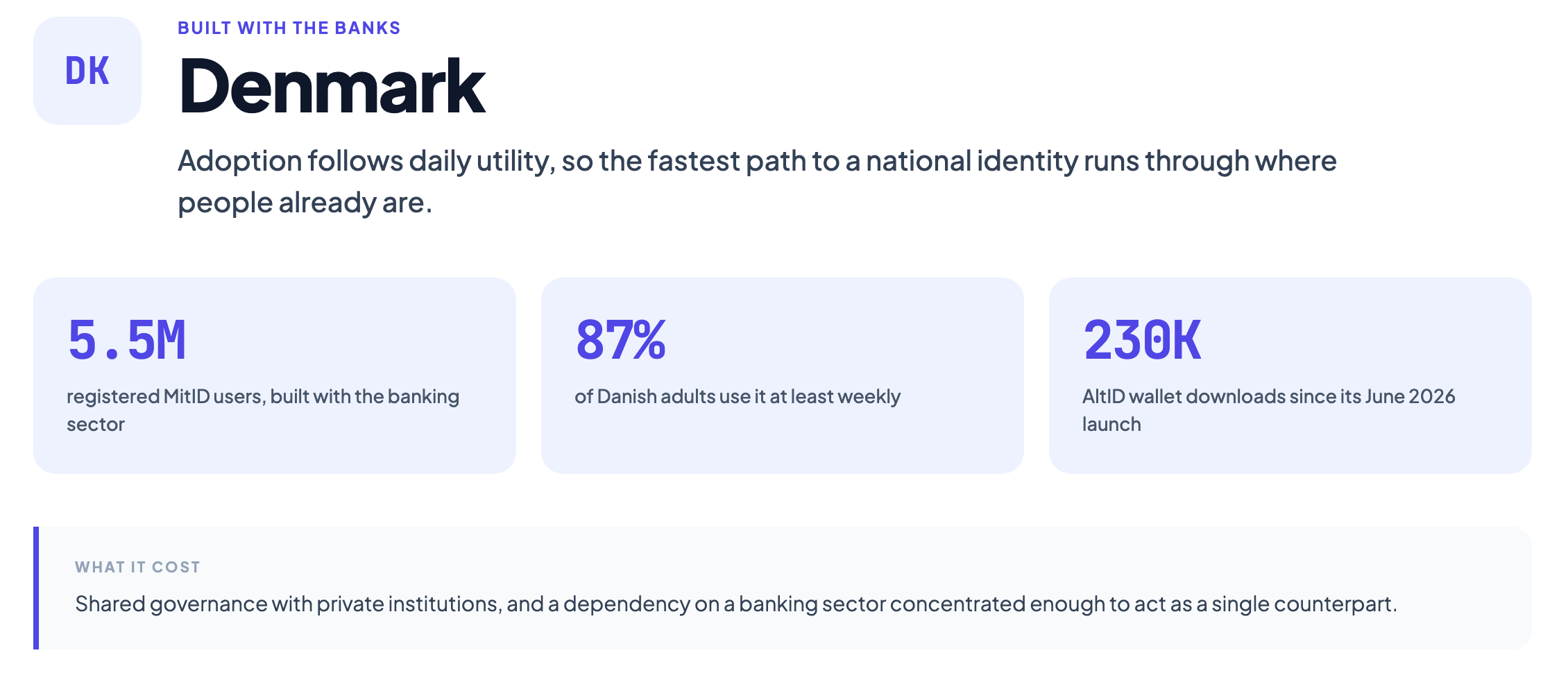
Denmark answered a different question: where do citizens already prove who they are, every week, without being asked twice? The answer was online banking, so the Danish system was built as a public-private partnership with the banks. MitID has around 5.5 million registered users, roughly 87% of Danish adults use it at least weekly, and the app averaged 3.3 million monthly active users in June 2026. It works for taxes, health records, and public services, and equally for private banking and insurance, which is why it is used weekly rather than annually.
Denmark is now taking the next step. In June 2026 it launched AltID, one of the first official digital identity wallets in the EU, holding an ID card and an age certificate locally on the device rather than in a central store. Adoption is early — roughly 230,000 downloads by late July, about 4% of the MitID base — and the direction is what matters, because it moves proof of age and identity to the phone with the citizen holding the data. That shift is the subject of our June edition on privacy-preserving age verification.
The bet: that adoption follows daily utility, so the fastest path to a national identity is the one that runs through where people already are.
What it cost: shared governance with private institutions, and a dependency on a banking sector concentrated and cooperative enough to act as one counterpart. In a market with hundreds of fragmented institutions, the same partnership is far harder to assemble.
What travels to Latin America, and what does not
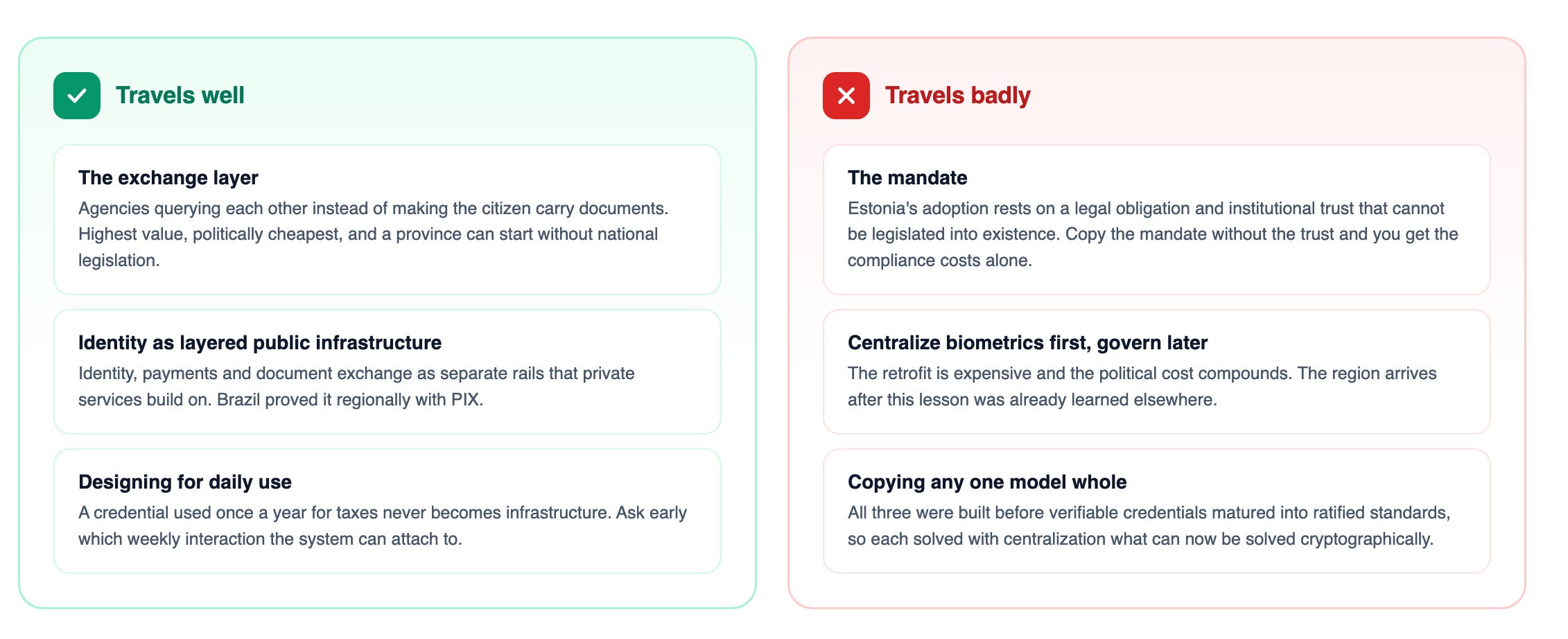
Travels well: the exchange layer. Every one of these systems works because agencies can query each other rather than making the citizen carry documents between them. This is the single highest-value component, it is politically far cheaper than a mandatory national credential, and it is the piece a province or a municipality can start on without national legislation.
Travels well: layering identity as public infrastructure. Treating identity, payments, and document exchange as separate rails that private services can build on is what turned India’s investment into an ecosystem. Brazil demonstrated the same effect with PIX.
Travels well: designing for daily use. Denmark’s lesson is the cheapest to apply and the most often ignored. A credential used once a year for taxes never becomes infrastructure, so the question worth asking early is which weekly interaction the system can attach itself to.
Travels badly: the mandate. Estonia’s near-universal adoption rests on a legal obligation and a level of institutional trust that cannot be legislated into existence elsewhere. Programs that copy the mandate without the trust get the compliance costs and none of the adoption.
Travels badly: centralizing biometrics first and governing later. The retrofit is expensive and the political cost compounds. The region has the advantage of arriving after this lesson was learned, and the current generation of standards makes it avoidable: a credential the citizen holds, presented selectively, with the issuer verifiable and the personal data never pooled.
The genuinely new option is that none of these three models has to be copied. All three were built before verifiable credentials matured into ratified standards, and each one solved with centralization or with legal mandate what can now be solved cryptographically. A jurisdiction starting today can get Estonia’s once-only principle without Estonia’s mandate, and India’s reach without India’s central database, because the credential travels with the citizen and any office can verify it independently. That compounding is the subject of how the layers of a trust stack build on each other.
Worth reading this week
The EU digital identity wallet deadline is the story to watch for the rest of the year. Every member state must offer at least one certified wallet by 24 December 2026, and current readiness assessments put fewer than a third of them on track. Denmark’s AltID is one of the first live examples, which makes its adoption curve the most informative public data point available on how citizens take up a wallet when it is genuinely offered.
The OECD Digital Government Outlook 2026 measures 36 members on the same progression these three countries illustrate: the average Digital Government Index rose from 0.61 to 0.70 between 2023 and 2025, with 74% of core digital public infrastructure components now in place. Its central recommendation — that governments require or strongly incentivize the use of shared building blocks instead of siloed agency projects — is the Estonian architectural lesson stated as policy.
The UN E-Government Knowledgebase remains the best free way to place any country against two decades of comparable survey data before deciding which model to borrow from.
Continue the conversation
More on verifiable credentials, document management, and digital public infrastructure — including case studies and reference architectures — is at sovra.io/knowledge.
Subscribe to The Identity Brief, published every week.