


Every time a citizen wants to perform a government procedure, they prove who they are. They show an ID, fill out a form, wait for someone to check a database. Then they walk into a different government office and do the exact same thing again.
A single citizen repeats this process five or six times in one month across health, education, tax, and civil registry services. Not because the information does not exist digitally, but because the systems that hold it were never designed to talk to each other.
This edition explains how verifiable credentials solve that problem at the architecture level, and why governments across the region are already deploying this approach.
How verifiable credentials change the architecture
A verifiable credential is a digital certificate that carries cryptographic proof of who issued it and what it says.
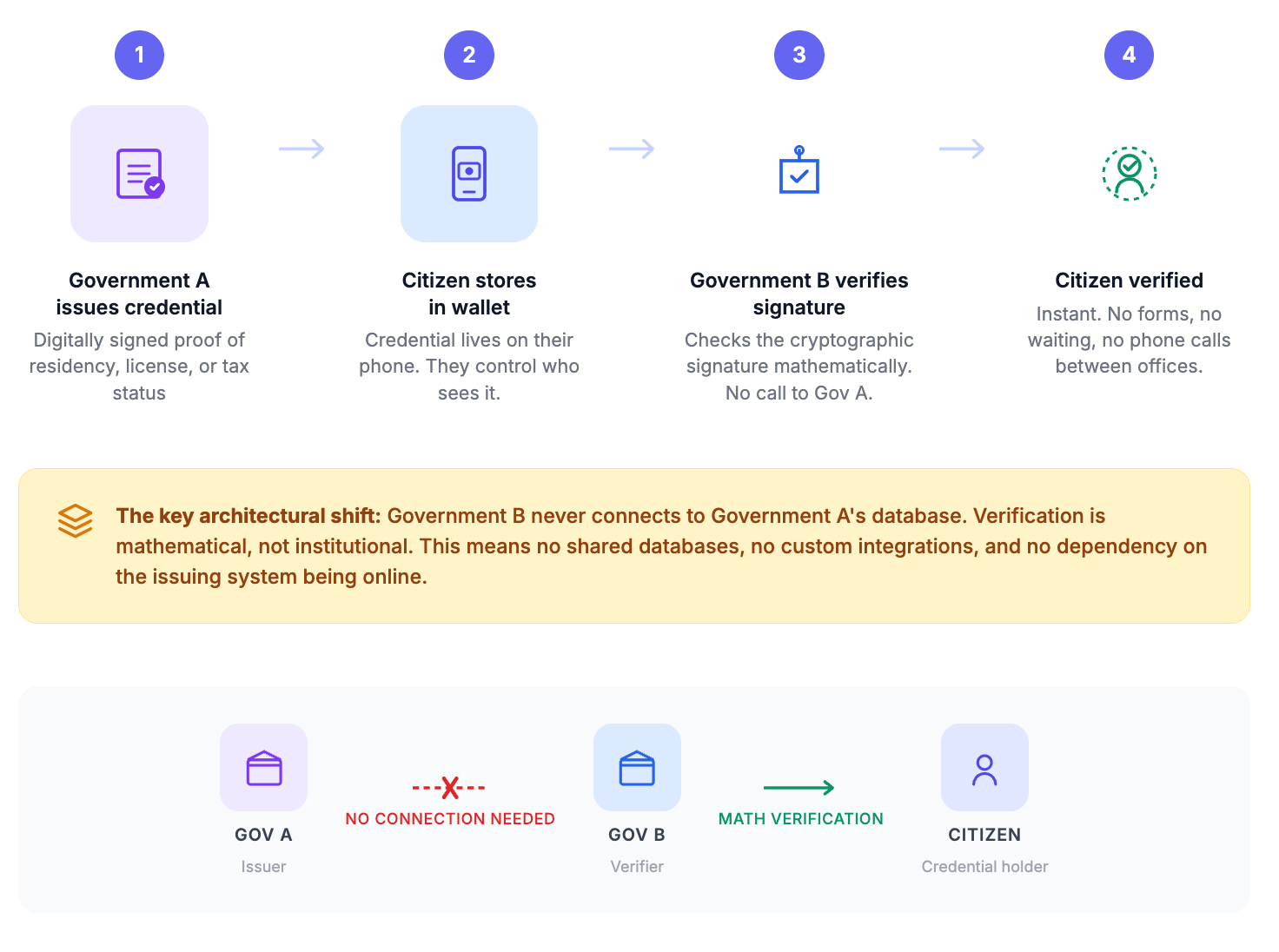
When a government issues a verifiable credential to a citizen (proof of residency, a professional license, a tax status), that credential lives in the citizen’s digital wallet. The citizen controls it. They decide when to present it and to whom.
The shift is in the verification. When a different government office needs to check that credential, they do not call the issuing office. They do not access the original database. They verify the cryptographic signature mathematically. If the signature is valid, the credential is authentic — in seconds, offline if needed, with no dependency on the issuing system.
A credential issued by a municipal government can be verified by a provincial government, a federal agency, or a private institution, all without sharing databases or building custom integrations.
Want to see this in action? Try the interactive SovraGov experience — walk through credential issuance and verification in real time.

What this looks like in practice
A citizen receives a verifiable credential from their local government confirming identity and residency, stored in their digital wallet on their phone.
When they access a health service run by the provincial government, they present the credential. The health system checks the cryptographic signature against the municipal government’s public key. If it matches, the citizen is verified. No forms. No waiting. No phone calls between offices.
The same credential works for education enrollment, tax filing, banking onboarding, or any service that needs to confirm who the person is. Each verifier independently confirms authenticity using the same mathematical check. The citizen never loses control of their data.
The network effect: why this scales
This architecture becomes more powerful as more institutions participate. Every new government that issues verifiable credentials adds value to every citizen’s wallet. Every new verifier makes the credential more useful.
In Latin America, multiple jurisdictions are deploying this infrastructure simultaneously. One state government reduced bureaucratic steps by 30 percent. A municipality digitized over 100 citizen services in a matter of months. The technology is the same across all of them because it is built on open standards (W3C Verifiable Credentials and Decentralized Identifiers), which means credentials from one deployment are verifiable by any other.
Cross-government credential infrastructure serves the entire ecosystem, because every institution that joins makes every other institution’s credentials more useful.
We discussed this topic deeply in Sovra Podcast #03 — Luis Papagni: Evolution of Digital Government and Identity in Latin America
Who benefits and how
Citizens go from proving themselves at every door to verifying once and using that verification everywhere. A single wallet replaces dozens of accounts, passwords, and in-person visits.
Governments stop maintaining expensive, redundant identity systems. They rely on credentials issued by other trusted institutions — reducing cost, processing time, and manual errors.
Private sector — banks, fintechs, insurance companies, employers — can verify government-issued credentials without building direct integrations with government databases.
Where this is heading
Cross-government credential verification is already live in several Latin American jurisdictions, with more planned for 2026. The approach works. The remaining variable is how fast the network grows.
Every government that joins makes the wallet more useful. Every credential type added (civil registry, education, health, professional licenses) makes the infrastructure more complete. Each deployment makes the next one easier and more valuable.
For millions of citizens across the region who already interact with digital government identity, the path to a single, reusable credential is shorter than most people realize.
Go deeper
How verifiable credentials work: the complete guide — 25-section technical guide covering VCs, DIDs, zero-knowledge proofs, and selective disclosure
Government use cases for reusable identity — Citizen ID, social benefits, licenses, tax documents, cross-agency verification
W3C Verifiable Credentials Data Model v2.0 — The open standard behind cross-government interoperability
Try the interactive demo — See credential issuance and verification in action
If this edition was useful, share it with someone in government digital services. The more people who understand this architecture, the faster it gets adopted.
The Identity Brief is published by Sovra. We build reusable identity infrastructure for governments and citizens across Latin America.