Introducing Propia: A Public Trust Layer for Verifiable Digital Credentials
Developed in collaboration with LambdaClass and Aligned, this open protocol establishes a framework for verifiable digital credentials and the institutions that issue them.
The whitepaper describes how Propia works. This article explains why we believe it is needed.
As governments digitalize identity, licences, diplomas, records and other official documents, a problem appears that better credentials alone do not solve: every institution needs a reliable way to know who is allowed to issue them, under whose authority, and whether they are still valid.
Today, that trust is usually established through direct queries, system-to-system integrations or bilateral agreements between institutions. It is a model that can work at a small scale, and one that becomes progressively harder to sustain once hundreds of agencies, several vendors and multiple jurisdictions are involved.
Propia starts from a simple thesis: institutions do not need to share their databases or adopt the same rules in order to trust one another. What they need is common infrastructure that lets them verify that trust independently.
Building on that idea, the whitepaper proposes an open architecture in which governments and institutions keep their own authority and their own systems, while sharing a common way to verify issuers, credentials and status.
That is the problem this piece sets out to explore.
The underlying problem
Institutions verify the same facts over and over. Someone already identified by the state may have to submit similar information to a university, a bank, an employer or any other agency, and each verification can require new integrations, callbacks to the issuer and additional copies of personal data.
Verifiable credentials make that verification reusable. An authorized institution can establish a fact and issue a signed credential, which can then be presented to other verifiers, who are able to check its authenticity, its issuer and its current status without going back to the issuer on every occasion.
But for this to work at scale, one fundamental question remains: how does a verifier know that an institution is authorized to issue a given credential, and that the authorization still holds?
Common infrastructure, without centralizing authority
Open standards already define how credentials are issued, signed and presented. What they do not settle on their own is how to verify who is authorized to issue them, under which rules, which keys they control, and what their current status is.
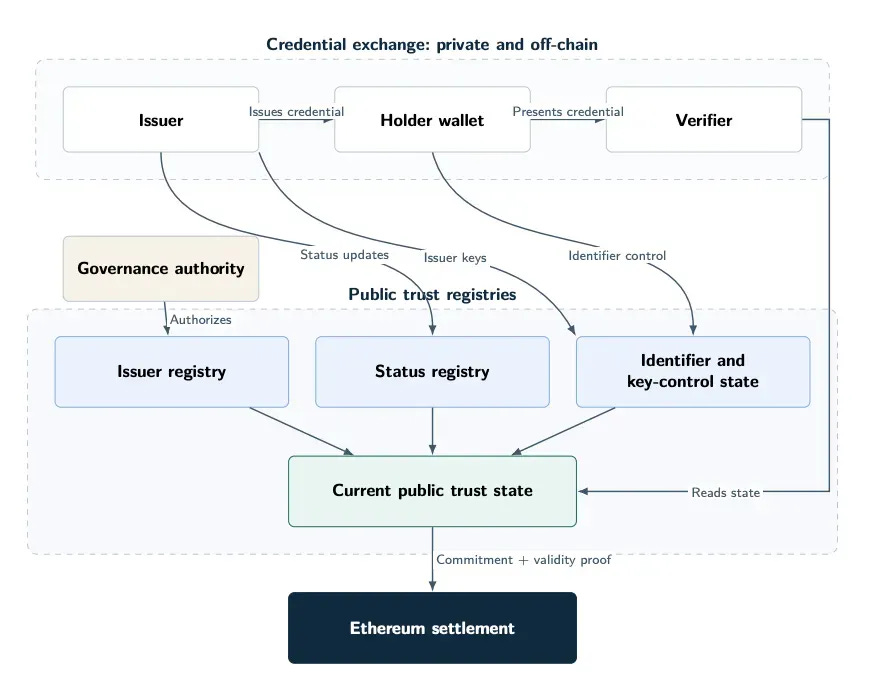
Propia provides that common infrastructure. Credentials and personal data remain between issuers, holders and verifiers, while the public state allows authorizations, keys and credential status to be checked independently.
This reduces the reliance on direct callbacks to the issuer, avoids duplicated integrations, and allows one institution to rely on a credential issued by another without any access to its internal systems.
Figure 2 of the whitepaper — private credential exchange and public trust settlement remain separate.
Interoperability without giving up sovereignty
One jurisdiction does not need to adopt the rules of another for its credentials to be verifiable beyond its borders. A government can issue an identity credential, a university can rely on it to issue a diploma, and a regulator can rely on both to issue a licence, while each institution keeps its own criteria and its own responsibilities.
Common infrastructure allows those credentials to compose into the processes of other institutions without building a new integration for every relationship.
Designed as open infrastructure
Infrastructure that may remain in use for decades should not depend on a single vendor, a single application or a single administration.
That is why Propia commits to open specifications and open implementation, independent verification, exit rights and transparent governance. Blockchain is used to make the common state of the registries verifiable, not to store credentials or personal data.
Propia is published as an open proposal, rather than a closed product. We want to discuss it, improve it and build on it together with the governments, public agencies, universities, regulators and vendors that will issue and verify the credentials of the future.