


There’s no shortage of data on digital government in Latin America. But none of these benchmarks answer a more specific question: which countries actually have the infrastructure and institutional momentum to support verifiable digital credentials at scale?
That’s the question behind the LATAM Digital Identity Index — a composite ranking of 9 economies across 5 dimensions, combining public indicators with field-level assessments of digital identity ecosystems and verifiable credentials adoption.
The full ranking and methodology are on the page. But here’s what the numbers actually reveal.
1. Uruguay is quietly building the strongest foundation in the region
Everyone expects Chile to lead. And it does — with the fastest business registration and a mature digital identity ecosystem through Clave Única.
But Uruguay is the story worth watching. It has the highest e-government maturity score in all of Latin America (90 on the UN EGDI — higher than Chile’s 88). Its service speed is nearly as fast. Its connectivity matches Chile at 92%.

Uruguay’s composite of 88.3 puts it firmly in the “Leader” tier. If it continues investing in verifiable credentials infrastructure — the one area where it still trails Chile — it could take the top spot within a year. Its compact, well-connected population makes it one of the most promising environments in the region for deploying digital public infrastructure — the kind of foundational layer that products like SovraGov are designed to provide.
2. Strong e-government doesn’t mean strong identity infrastructure
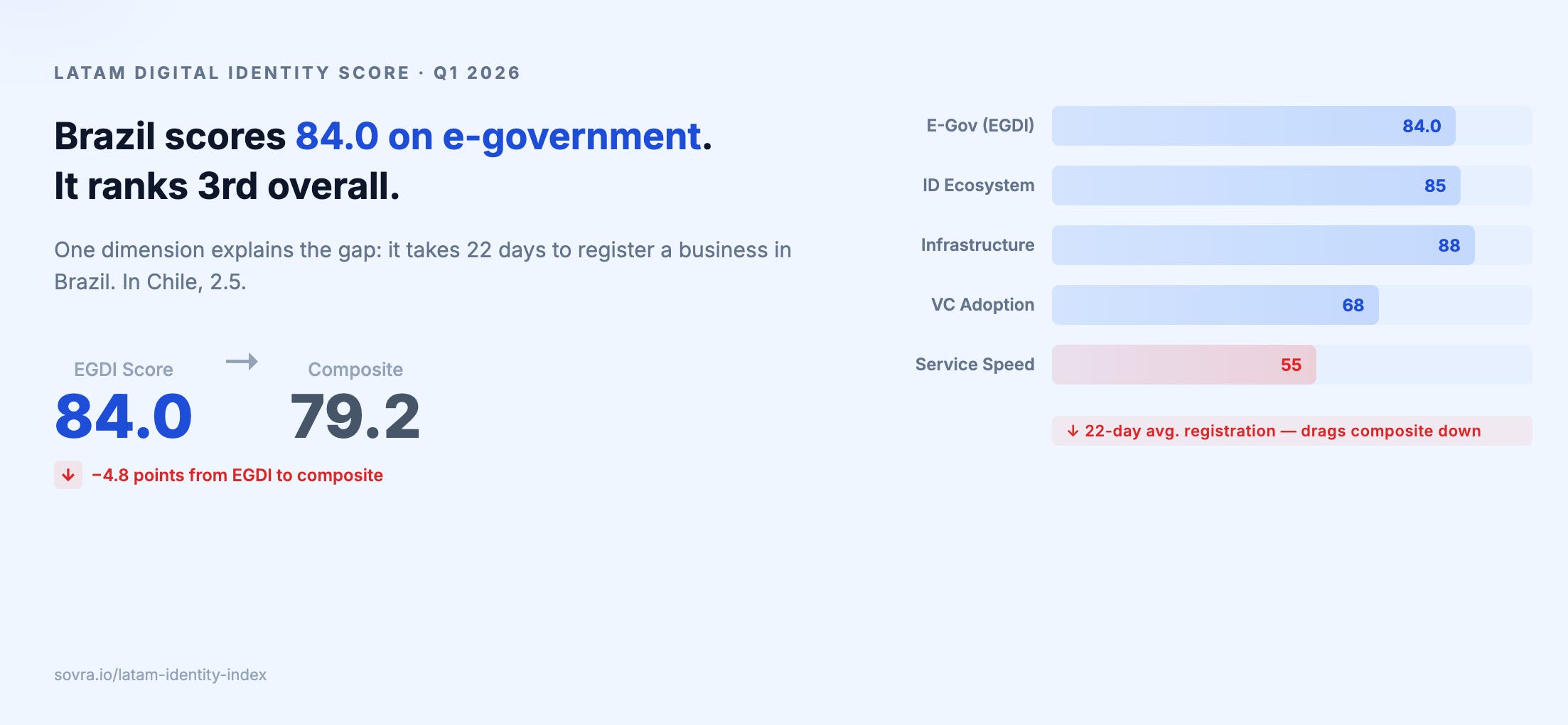
This was the most counterintuitive finding. Brazil scores 84.0 on the UN EGDI — world-class. Its gov.br platform serves over 150 million citizens. By any traditional measure, Brazil should be the clear regional leader.
It ranks third, at 79.2.
The gap comes from service speed. Registering a business in Brazil takes roughly 22 days. In Chile, 2.5. That single dimension pulls Brazil’s composite down significantly — and it reveals something important: having a sophisticated digital government platform doesn’t mean the underlying bureaucratic processes have caught up.
This is exactly the gap that verifiable identity systems are designed to close. When a citizen or business can prove who they are with a cryptographic credential instead of physical documents, the verification step drops from days to seconds. That’s the core of what SovraID enables — open-source infrastructure for creating, managing, and verifying decentralized identifiers and verifiable credentials that any government can deploy.
3. The middle tier is where the real opportunity is
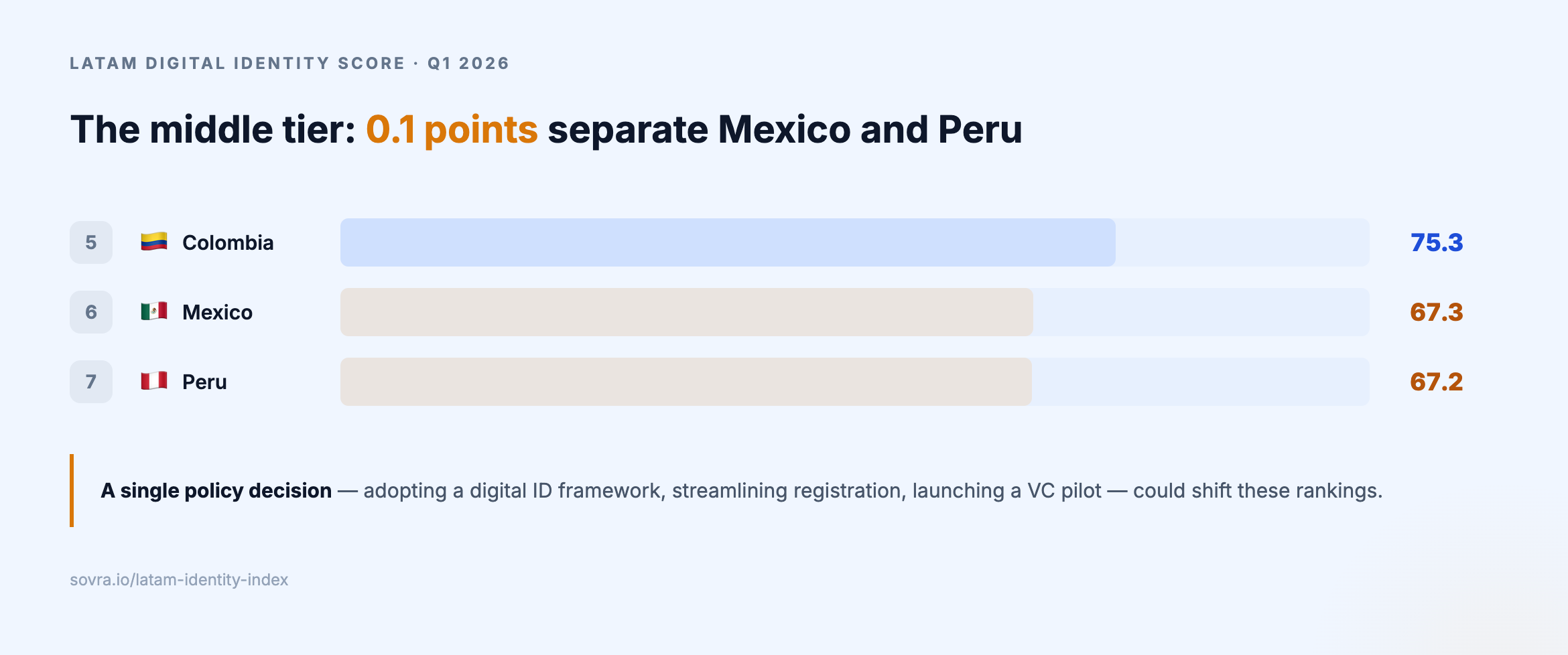
Chile and Uruguay have separated from the pack. Bolivia and Ecuador have a long road ahead. But between ranks 5 and 7, the scores are remarkably tight.
Mexico and Peru are separated by one-tenth of a point: 67.3 vs. 67.2. Colombia sits above at 75.3 but is closer to Mexico than to Brazil. A single policy decision — adopting a digital ID framework, streamlining registration, launching a verifiable credentials pilot — could shift these rankings meaningfully.
For governments in this tier, the question isn’t whether to modernize identity infrastructure — it’s how fast. The countries that deploy credential systems first create compounding advantages: faster services attract more digital adoption, which generates more data, which makes the systems more useful. That’s why SovraWallet was designed as a non-custodial digital wallet where citizens control their own credentials — adoption scales faster when people trust the system because they own their data.
What to watch next
Two trends will reshape these rankings.
First, verifiable credentials adoption will separate the tiers. Right now it’s weighted at 15% of the composite. But as countries move from pilot to deployment, the practical distance betwee n those with active programs and those without will widen beyond what scores suggest. SovraChain — our Ethereum Layer-2 rollup using Validium architecture — was built for exactly this moment: credential verification at national scale, with privacy by default through zero-knowledge proofs.
Second, business registration speed is the most actionable lever. Countries like Mexico and Peru with strong digital platforms but slow processes are sitting on easy gains — and verifiable identity infrastructure is one of the fastest ways to unlock them.
The Q2 edition of the index will update these rankings as new data comes in. Subscribe to The Identity Brief to get it when it drops.
The LATAM Digital Identity Index is published quarterly by Sovra. Methodology combines UN EGDI data, World Bank B-READY indicators, ITU connectivity statistics, and proprietary analyst assessments across identity ecosystems and verifiable credentials readiness.