



CIDI (Ciudadano Digital, “Digital Citizen”) is the digital identity platform of the Province of Córdoba, Argentina: a single login that tells every provincial service who a person is, at a known level of confidence, so each service can grant access without asking for proof again. It launched around 2014 as a site for a handful of self-service procedures, and today almost 4 million people use it to reach more than 400 of them, from birth certificates to company registration.
Behind that login the conversation takes apart three layers: two levels of identity assurance, an interoperability platform that connects systems owned by different ministries, and a team that builds most of the stack in-house on free software. As Lucas put it during the conversation, digital identity is a means to an end, and what matters is the set of services behind it.
In this episode of Sovra Podcast, Lucas Jolías speaks with Walter Caudana, Undersecretary of Management Innovation of the Government of Córdoba, who leads CIDI today. Walter spent years in the technology sector and then in public service, first as director of systems for the City of Córdoba and now at the provincial level. He describes the platform the way an engineer describes a system he maintains: how it is layered, what broke and got replaced, which decisions kept it alive through several administrations, and what the team is building next.
What You Will Hear
1. A self-service site that became the front door
CIDI launched around 2014 as a place where people could manage a few procedures on their own. Over the following decade the team kept adding services until it became, in Walter’s words, an ecosystem of integrated digital services. The everyday uses explain the reach: birth and marriage certificates, school enrollment, applications for provincial benefits such as subsidized transport tickets and school meal programs for students in vulnerable households, a fishing licence for a weekend on Córdoba’s rivers, and the registration of a simplified company (SAS) entirely online, signed with a digital signature inside the platform.
2. A law, and then daily use
Lucas asked why CIDI survived administrations of different political colours when many digital policies do not. Walter pointed first to Law 10.618 on the simplification and modernization of public administration, sanctioned in 2019, which promotes digital identity, the digital case file, the electronic signature and an electronic administrative address where the State can formally notify citizens. Once the whole administration was required to work this way, Walter says, there was no going back. Lucas added the second leg, and Walter agreed: the law protects a policy, and daily use is what makes it impossible to replace.
3. Two levels of assurance and almost 4 million users
CIDI separates accounts by level of assurance, meaning how sure the government is that the person behind the account is who they claim to be. Level 1 asks only for an email and a national tax or ID number. Level 2 validates the person with biometrics, a face check against official records, and it is the level that unlocks sensitive procedures. Of almost 4 million active users, more than 2.5 million are at Level 2. The total is close to the province’s population because the platform is free and open to anyone who deals with the Córdoba government, including people who live elsewhere but run a business, work or pay taxes in the province. Today more than 400 procedures are available, and Walter estimates that 70 to 80 percent of them can be completed entirely online.
4. A shared highway behind the screen
The single login is the visible part. The harder work is what Lucas called stitching the back office together, so the treasury, transport and licensing systems behave like one State for the citizen. Walter describes how the Secretariat of Innovation deployed an interoperability platform, a common channel through which systems owned by different ministries exchange data in a standard way. Each area kept ownership of its own service and gained a “communication highway” to everything else, with no extra effort on its side. The platform itself has been rebuilt twice, from an Oracle Service Bus to Talend and now to a newer stack that uses AI tools to monitor performance and anticipate outages before they happen. We looked at the same layer from the verifier’s side in A Signature Isn’t Enough: The Keys to Interoperability, which explains what a receiving system needs beyond a valid signature.
5. Built in-house, shared outward
On technological sovereignty, Walter’s answer is concrete. The province bets on in-house development with free software, working alongside local university teams such as those at UTN (the National Technological University) and recruiting the strongest people into the provincial staff. Private suppliers contribute when the State needs extra capacity, and the province sets the guidelines and keeps the knowledge. The team avoids turnkey software entirely, which means the government can modify the code and make it available to others: Córdoba has already helped other provinces launch their own Ciudadano Digital on top of its codebase. Inside the province, hundreds of municipalities that sign a framework agreement let residents log in with Level 2 and use CIDI’s notification and appointment tools at low cost, and organizations such as the provincial bank, the electricity company and professional associations use CIDI to notify people and validate access. Lucas summed it up as public infrastructure: a layer the government, a town hall, a bank and a utility all build on, a pattern our Ep. 10 with Mauro Solano explored across Argentina’s provinces.
6. From a digital service window to an assistant
Asked where CIDI will be in three to five years, Walter describes a change in posture. Today CIDI works like a digital service window: the citizen arrives, finds the procedure and completes it. The goal is an assistant that understands what the person needs and walks them through it, built on generative AI that today answers questions and should learn to guide. Three conditions come with it. The platform has to work for people who are not digital natives, so the team is investing in UX. Interoperability has to extend beyond the province, so someone from another part of Argentina who arrives to open a company can be served too. And identity itself has to travel: CIDI already issues credentials that are valid inside CIDI, and the next step is verifiable credentials, a digital document on your phone that any other party can check, showing only what you choose to share. That is the same model behind Peru’s national ID in Ep. 11, and the full lifecycle of a verifiable credential walks through how it is issued, held and checked.
Key Quotes
“CIDI went from being a web page to the front door of the government’s digital ecosystem.”
“You owned your service, fine. We gave you a communication highway that let your service interact with others, simply and quickly, without any extra effort on your side.”
“We avoid any kind of turnkey software. Development is based on open-source solutions, where the government can make changes and make the software available for others to use.”
“The idea is for CIDI to stop being a kind of digital service window and become an assistant that walks alongside citizens.”
“We have to go from a State that tells you how it’s done to an assistant that helps you do it.”
About the guest
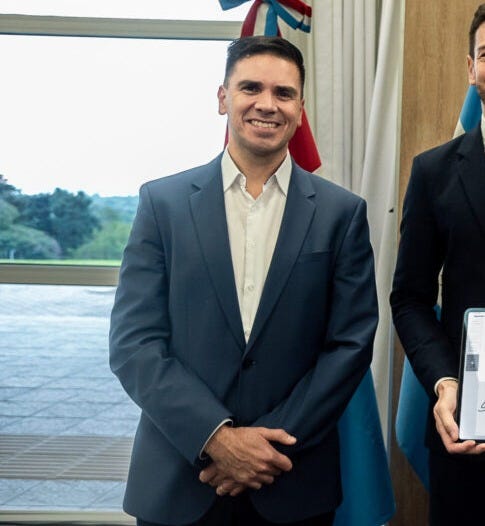
Walter Caudana is Undersecretary of Management Innovation of the Government of Córdoba, Argentina, where he leads CIDI, the province’s digital identity and services platform. He has many years of experience in the technology sector and in government, including his time as director of systems for the City of Córdoba. His lens is distinctive because he has run a digital identity platform at scale for years and talks about it as infrastructure: assurance levels, service ownership, the integration layer, the stack migrations and the in-house team that keeps it running across administrations.
More from Sovra
🎧 [PODCAST] Ep. 11: How Peru Issued Its National ID as a Verifiable Credential (with Héctor Saravia): the step CIDI is preparing for, taken at national scale by RENIEC.
🎧 [PODCAST] Ep. 10: The Provinces Are Not Waiting (with Mauro Solano): how Argentina’s 23 provinces and Buenos Aires City coordinate a common digital agenda.
📖 A Signature Isn’t Enough: The Keys to Interoperability: what a receiving system checks when a credential comes from somewhere else.
📖 How a Country Verifies an Identity Issued by Another: the cross-border version of the interprovincial question Walter raises.
Worth reading this week
CIDI, Ciudadano Digital: the platform itself, with its procedures and access levels.
Law 10.618 of the Province of Córdoba: the 2019 law on administrative simplification and modernization (in Spanish).
W3C Verifiable Credentials Data Model v2.0: the standard behind credentials that any party can verify.
Continue the conversation
Explore the standards and building blocks behind these ideas at sovra.io/knowledge, our hub for digital identity and verifiable credentials. If you are working on the credential layer Walter describes, SovraID covers issuing and verifying credentials, and SovraGov covers the service layer on top. More at sovra.io.
We read every response, so reply and tell us what made digital identity stick where you work. Forward this to someone building a citizen platform.
Subscribe to The Identity Brief, published every Thursday.
🎧 Listen to the full episode on YouTube: [link YouTube pendiente]
The Identity Brief is published weekly by Sovra, the Digital Identity Stack for the Institutional World.