



Most governments approach interoperability as a technical problem: pick a standard, build the integration, connect the systems. The countries that have actually succeeded at it tell a different story. They started with the institutional layer first — who owns the data, who has authority to share it, what the standards encode about governance — and let the technology follow.
Estonia is the canonical example: X-Road, launched in 2001, is often described as a piece of technology. It is more accurately a philosophy that happens to be implemented in software. When a citizen consumes a service through it, the system names the organization that owns the data, the area within that organization, the system, and the service. That is digital sovereignty made concrete at the architecture level.
In this episode of Sovra Podcast, Dolores Collazo speaks with Gustavo Giorgetti, Founder of ThinkNet S.A. and researcher at Universidad de San Andrés, one of the architects behind Argentina’s interoperability ecosystems across Neuquén, Mendoza, San Juan, and four other provinces. Gustavo started working on interoperability in 2010, when explaining the concept meant loading computers into a truck and physically demonstrating data flowing between systems on a meeting table. Sixteen years later, what he and a generation of Argentine practitioners have built is a federal model that respects provincial autonomy while enabling cross-jurisdiction queries at production scale.
What You Will Hear
1. Why X-Road is institutional before it is technical The standards Estonia embedded into X-Road encode governance — data ownership, organizational authority, named services. The technology is downstream. Gustavo explains why countries that approach X-Road as a tech selection consistently fail to capture its real value.
2. The Argentine federal model and why it scales Estonia is small and unitary, so 100% of services can run through a single interoperability spine. Argentina is federal, with autonomous provinces. The adaptation: each province runs its own ecosystem. Seven jurisdictions are now interoperating, with a federation across six confirmed in March 2026. Mexico and Brazil are already replicating the pattern. “Argentina has more ecosystems than any country in the world,” Gustavo says, “because we are respecting federalism.”
3. The first federated use case: food-debtor registries A debtor cannot owe in one province and escape into another. Cross-province queries now happen institutionally, in the background, with full audit trail, no database copy. The query collects information across federated provinces and returns a yes/no — preserving privacy, preserving provincial autonomy, eliminating the loophole.
4. Mendoza incorporates a company in two hours Nine separate public registries talk to each other behind a single citizen-facing entry point. Step one is the company name. Step two is payment. Step three is operational. The same legal entities exist, the same fiscal obligations exist, but the experience collapses into a single interaction. Estonia does it in fifteen minutes. Mendoza is second in the world.
5. The two layers: back-end + front-end Interoperability operates at two layers, and most projects only build one. Back-end interoperability is X-Road — institutional exchanges in the background. Front-end interoperability is the citizen carrying their own credential — a verifiable credential issued by an institution, held in a wallet, presented to any verifier inside or outside the original ecosystem. The two compound: X-Road queries can trigger verifiable credentials issued dynamically in real time, only when the citizen needs to present one outside the ecosystem.
6. AI agents as the next frontier The closing of the conversation lands on what makes this architecture matter for the next decade. As AI agents start acting on behalf of citizens — booking, paying, applying, verifying — they need a way to prove legitimacy to verifiers. The same verifiable credentials that anchor citizen identity become the credentials the agent carries. Gustavo cites Nvidia’s CEO at a recent industry event: “Structured data is the true foundation of AI.” Digital public infrastructure built on interoperable standards IS that structured data layer.
Key Quotes
“When you use a service under X-Road, you are using the institutionality of the government. That is digital sovereignty.”
“DPI is what is outside of organizations. People arrive with technological solutions for inside their borders, but the problem of digital public infrastructure is outside — where exchanges happen, where transfers happen.”
“Argentina has more ecosystems than any country in the world, simply because we are respecting federalism.”
“Estonia does it in fifteen minutes. Mendoza does it in two hours. The only difference is that Mendoza has to wait for the official gazette to print the next day — but conceptually, nine public registries are already talking to each other behind a single entry point.”
“For me, verifiable credentials are the most important complement. They extend trust outside the borders of the ecosystem.”
About the guest
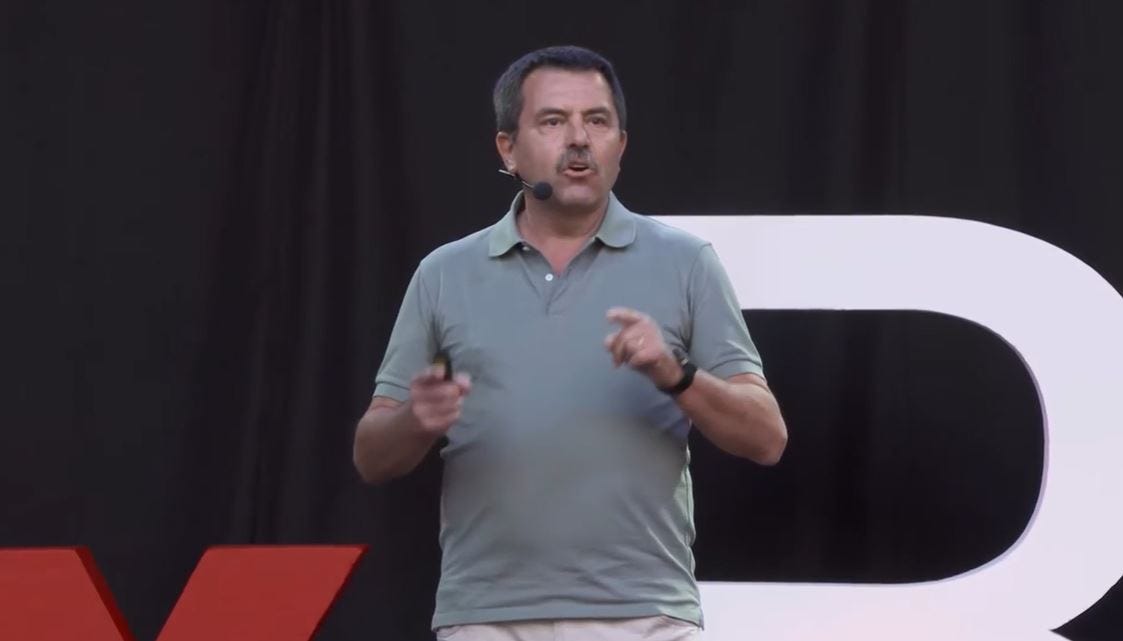
Gustavo Giorgetti is Founder of ThinkNet S.A. and researcher at Universidad de San Andrés in Argentina. He has worked on digital government and interoperability since 2008, with deep involvement in the design and implementation of provincial ecosystems across Argentina — including the foundational work in Neuquén starting in 2010, which became a laboratory for what is now a federated network. In August 2024, he presented to the ParlAméricAs Digital Caucus on Key Approaches to Safeguarding Digital Identity. His work focuses on the institutional and governance frameworks that determine whether technical interoperability translates into adopted, durable public infrastructure.
🎧 Listen to the full episode on YouTube
📚 Explore the concepts: Digital Public Infrastructure | Digital Public Goods | Reusable Identity | Verifiable Credentials | Evolution of Digital Identity | Real-World Use Cases
🌐 Follow Sovra: LinkedIn | X | YouTube
✉️ Subscribe: sovra.substack.com
🔗 Learn more: sovra.io
More from Sovra
📖 How a Verifiable Credential Outlives Its Issuer — the architecture of cross-institutional verification
📖 A Wallet for the Agent — Know Your Agent Credentials — credentials for AI agents acting on your behalf
🎧 [PODCAST] Ep. 7: From Digitalization to Infrastructure (with Aura Cifuentes)