


Sovra and POK Proof of Knowledge announce a strategic partnership to integrate digital identity and educational credentials into a single trust infrastructure built on open standards.
The goal of this collaboration is simple and concrete: reduce fragmentation between education, identity, and public services, and enable credentials to be issued, verified, and reused across institutional, educational, and governmental contexts.
What Sovra brings
Sovra builds digital identity infrastructure for governments, public institutions, and citizens. Its Digital Identity Stack enables the issuance, verification, and reuse of credentials with privacy by design, user control, and institutional sovereignty, aligned with open standards.
Sovra’s infrastructure is already live across Latin America, with deployments in countries such as Argentina, Mexico, and Colombia. Today, millions of people use Sovra-powered systems to access digital public services and manage verifiable credentials in real world public sector environments.
This operational footprint is key. Identity infrastructure only creates trust when it works at population scale, under regulatory constraints, and in critical institutional contexts.
What POK brings
POK is a leading platform for educational credentials and microcredentials, trusted by 1,100+ institutions across 19 countries, including Latin America, the United States, Europe, and Japan.
Universities and organizations use POK to issue blockchain-based, verifiable NFT credentials that are portable, independently verifiable, and internationally recognized. POK’s platform complies with global standards such as OpenBadge 3.0 (1EdTech) and the European Learning Model, ensuring interoperability across education and workforce ecosystems.
Why this partnership matters
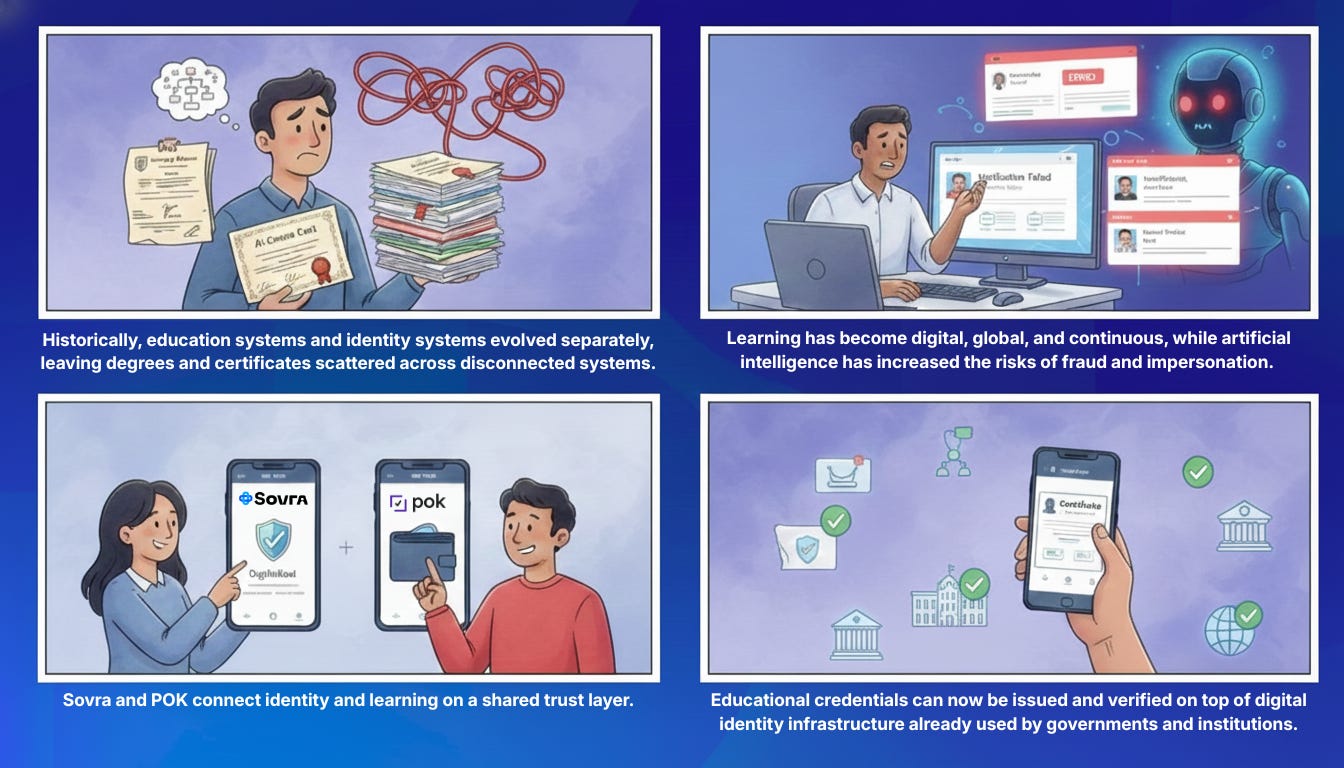
Historically, education systems and identity systems evolved separately. Educational credentials were issued in isolated platforms. Identity infrastructure was built for public services and civic use cases. As a result, diplomas and certificates remain hard to verify across institutions, jurisdictions, and sectors.
At the same time, learning has become digital, global, and continuous, while artificial intelligence has increased the risks of fraud and impersonation. In this context, credentials must be verifiable, reusable, and anchored in trusted infrastructure.
The Sovra–POK partnership connects these two worlds.
Educational credentials can now be issued and verified on top of digital identity infrastructure already used by governments and institutions. At the same time, identity systems can incorporate education as a trusted signal for public sector and institutional use cases.
What changes in practice
People can securely manage and present their educational credentials across educational institutions, workplaces, and government services. Credentials become reusable across different stages of life, rather than remaining locked to a single issuer or platform.
Institutions gain reliable verification grounded in open standards, without building custom integrations or relying on closed systems. Public services become more connected to real skills, qualifications, and learning pathways.
A shared belief
This partnership reflects a shared belief between Sovra and POK.
Digital trust must be sovereign, so institutions and individuals retain control.
It must be composable, so systems can interoperate and evolve.
And it must be built to last, supporting real use cases at real scale.
By connecting digital identity and educational credentials, Sovra and POK are building infrastructure for a future where trust moves as freely as people and knowledge do.