


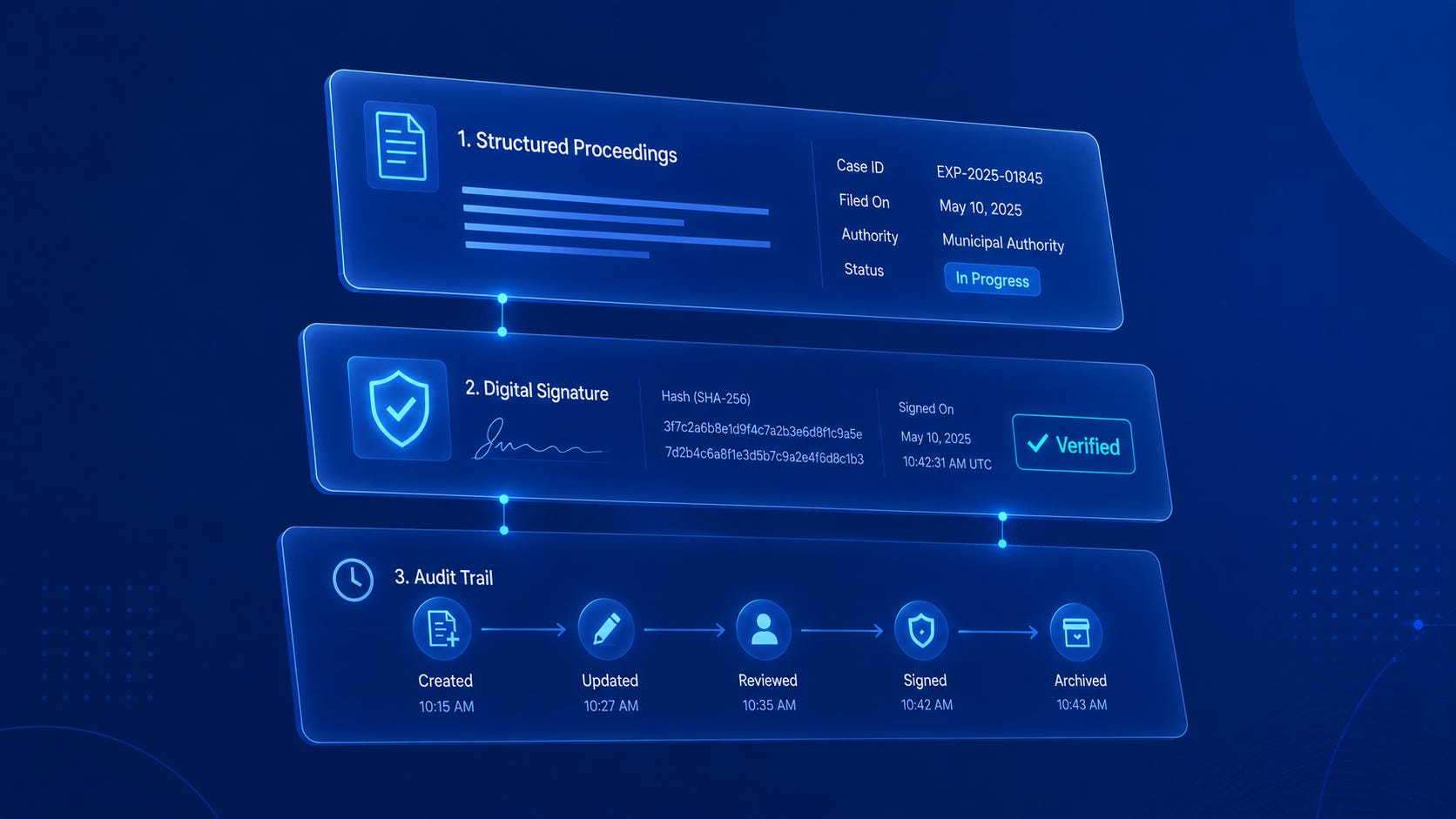
An electronic case file is the ordered set of every action in a government procedure — applications, technical reports, legal opinions, resolutions — in structured digital format, digitally signed, with a complete audit trail.
It carries the same legal validity as its paper equivalent, with one central operational difference: systems can search it, verify it, and act on it in seconds. The Inter-American Development Bank estimated in Wait No More that an in-person government transaction costs up to 40 times more than the same transaction completed online. Closing that gap is what platforms like SovraGov GDE 2 — running today in deployments serving 8M+ citizens across 20+ governments — are built for.
Digitized and digital are two different things
Scanning a paper file produces a collection of images: the file can be opened, but no system can read what it contains, who signed what, or where the procedure stands.
An electronic case file is born digital: each action is a structured document that systems can interpret, each signature is a cryptographically verifiable digital signature, and every movement is recorded. That distinction — the case file as a structured, signed document rather than a container of images — is what separates a digitized archive from a digital government.
The practical rule: the past gets scanned, the future is born electronic.
Electronic case file vs. document management system
A document management system stores and retrieves files. An electronic case file system does something stricter: it guarantees the ordered sequence of actions, preserves an unbroken signature chain across agencies, and exposes the state of every procedure to other systems. If your evaluation shortlist includes generic DMS tools, this is the dividing line to test: can the system tell you — programmatically — where a procedure stands, who signed each step, and prove none of it was altered?
How to implement an electronic case file: the four steps
1. Legal framework
Before the technology, the validity: a norm (decree, state law, or ordinance) recognizing the electronic case file and the digital signature as equivalent to paper. Most countries in the region already have digital-signature legislation in force; the work is usually to adhere or regulate, rather than legislate from scratch.
2. Document structure and signature
Define the format of each action (a structured document with metadata: type, date, author, agency) and the signature scheme — the usual standard is an advanced electronic signature on every action. This step determines everything downstream: a well-chosen format keeps the case file searchable, auditable, and automatable for decades.
3. Interoperability
A case file crosses agencies: intake desk, technical review, legal, final signature. The implementation needs a mechanism for different systems to read and append actions without breaking the signature chain — documented public APIs and a single registry of procedures.
4. Gradual migration
The deployments that work start with two or three high-volume procedures, prove the full circuit (digital intake → processing → signed resolution → notification), and expand from there. Historical paper is digitized as a searchable archive; the new flow is born electronic from day one. The IDB’s government digital transformation guide recommends exactly this sequence: framework, pilot, scale.
SovraGov GDE 2 covers all four steps out of the box — legal-grade signatures, structured documents, cross-agency APIs, and a proven pilot circuit. See it live.
Frequently asked questions
Is a signed PDF an electronic case file? A signed PDF is a valid electronic document, but a case file is more than a document: it is the ordered sequence of every action with its audit trail. When that sequence lives in folders of PDFs, systems cannot operate on it; the electronic case file structures it so they can.
Does it have the same legal validity as paper? Yes, in jurisdictions with digital-signature legislation in force — the vast majority of the region today. Validity comes from the norm plus the verifiable signature, the same principle behind the lifecycle of a verifiable credential.
How long does an implementation take? A pilot covering two or three high-volume procedures can be operational in months, not years; expanding to the full inventory of procedures is gradual and depends on each agency’s volume and regulations.
What happens to the existing paper files? They are digitized as a searchable historical archive. The practical rule: the past gets scanned, the future is born electronic.
Do we need to replace our existing systems? No. The interoperability layer (step 3) exists precisely so existing systems read and append actions through APIs. Replacement is optional; integration is the requirement.
Contact us
See SovraGov GDE 2 run a live case file circuit → Contact us.
Not evaluating yet? More guides and explainers at sovra.io/knowledge.
Subscribe to The Identity Brief — published weekly.