


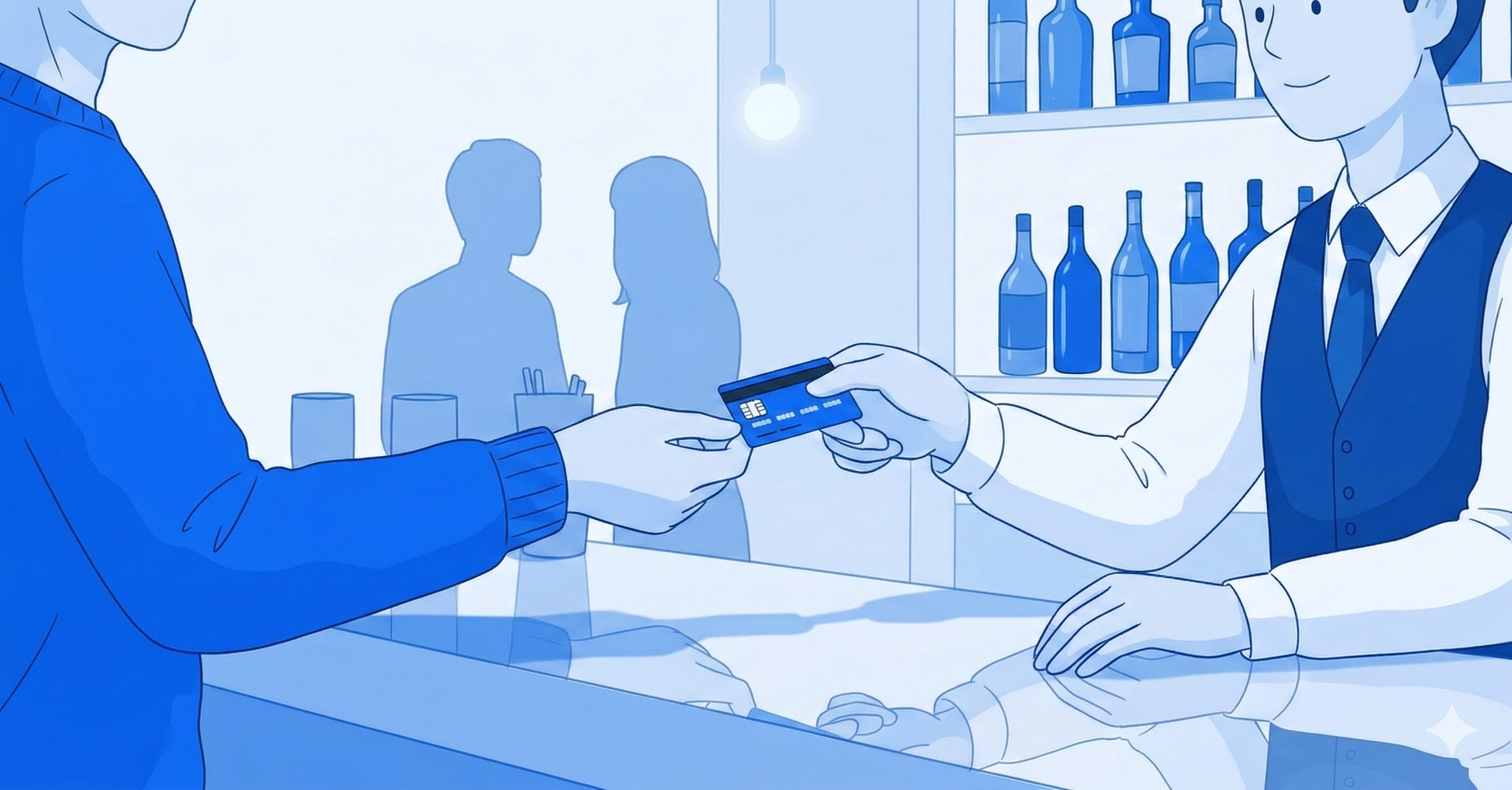
It’s Friday night. You walk into a bar and order a beer. The bartender asks you to prove you’re over 18.
You pull out your driver’s license and hand it over.
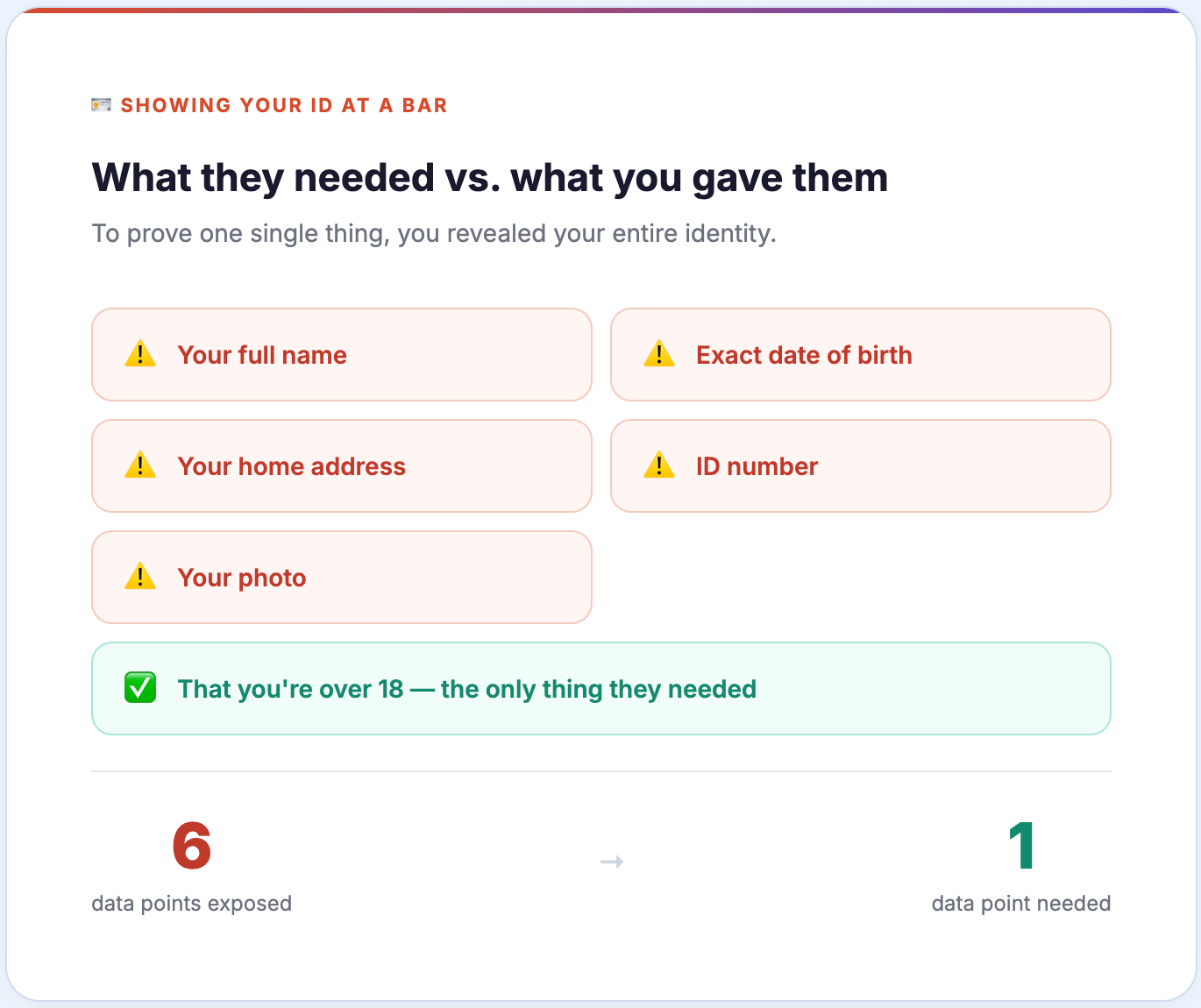
In those three seconds, a complete stranger just saw your full name, your exact date of birth, your home address, your ID number, and your photo.
Of all that information, they only needed one thing: that you’re over 18.
This scene plays out millions of times a day, all over the world, in contexts far more sensitive than a bar: applying for a loan, crossing a border, accessing a health service, verifying a university degree.
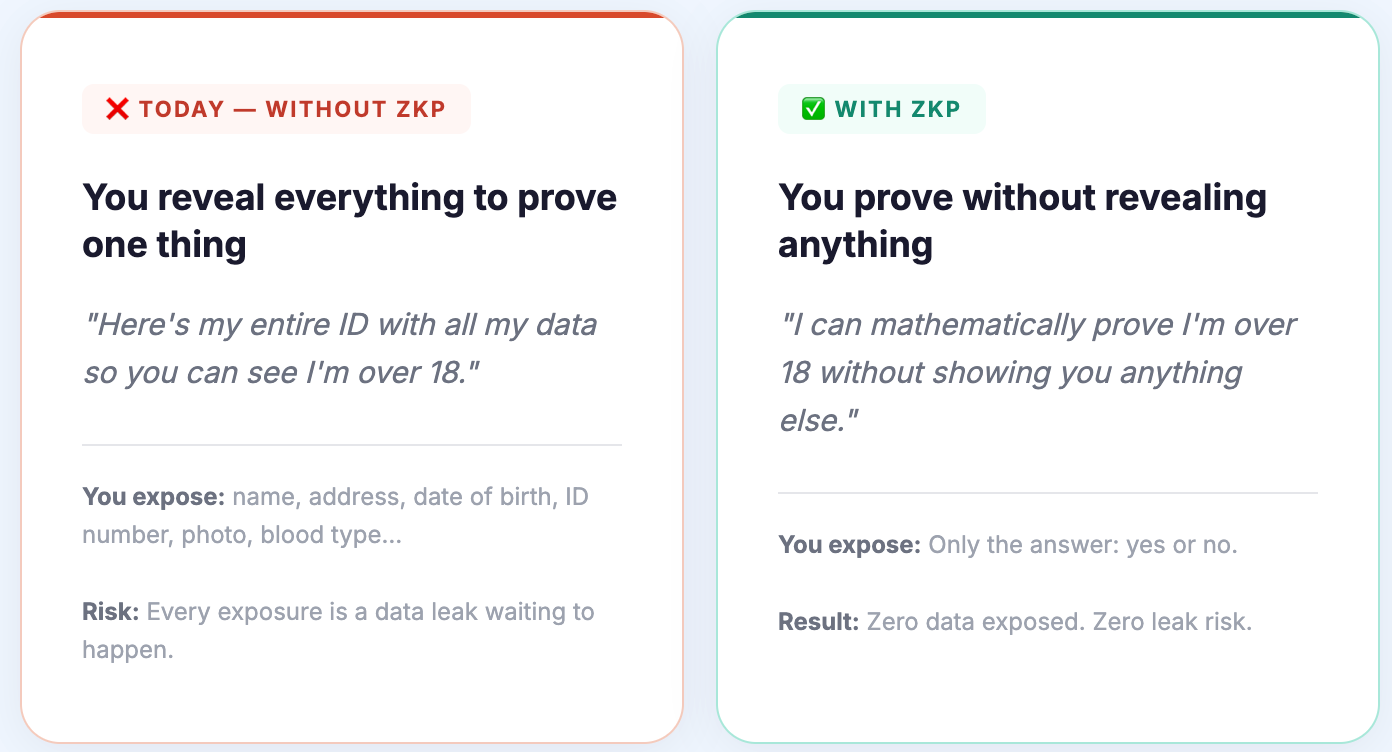
Every time, the system works the same way: to prove one thing, you have to reveal everything. Your entire identity gets exposed unnecessarily, over and over again.
What if there were a way to prove something is true without revealing the information behind that truth?
There is. They’re called Zero-Knowledge Proofs.
What Is a Zero-Knowledge Proof?
A Zero-Knowledge Proof (ZKP) is a cryptographic method that allows you to prove a statement is true without revealing any additional information beyond the truth of that statement.
Selective Disclosure: Show Only What’s Needed
ZKPs enable a concept called selective disclosure. Instead of presenting a complete document, you choose exactly which attribute to reveal.
Let’s go back to the driver’s license. With selective disclosure, the same credential could answer different questions while revealing only what’s necessary:
At the bar → Only reveals: “Over 18.” Hides: name, address, exact date, ID number.
At the car rental → Only reveals: “Valid Class B license.” Hides: address, date of birth.
At the pharmacy → Only reveals: “Active health coverage.” Hides: medical history, diagnoses.
At the bank → Only reveals: “Income above $X.” Hides: exact amount, employer, other assets.
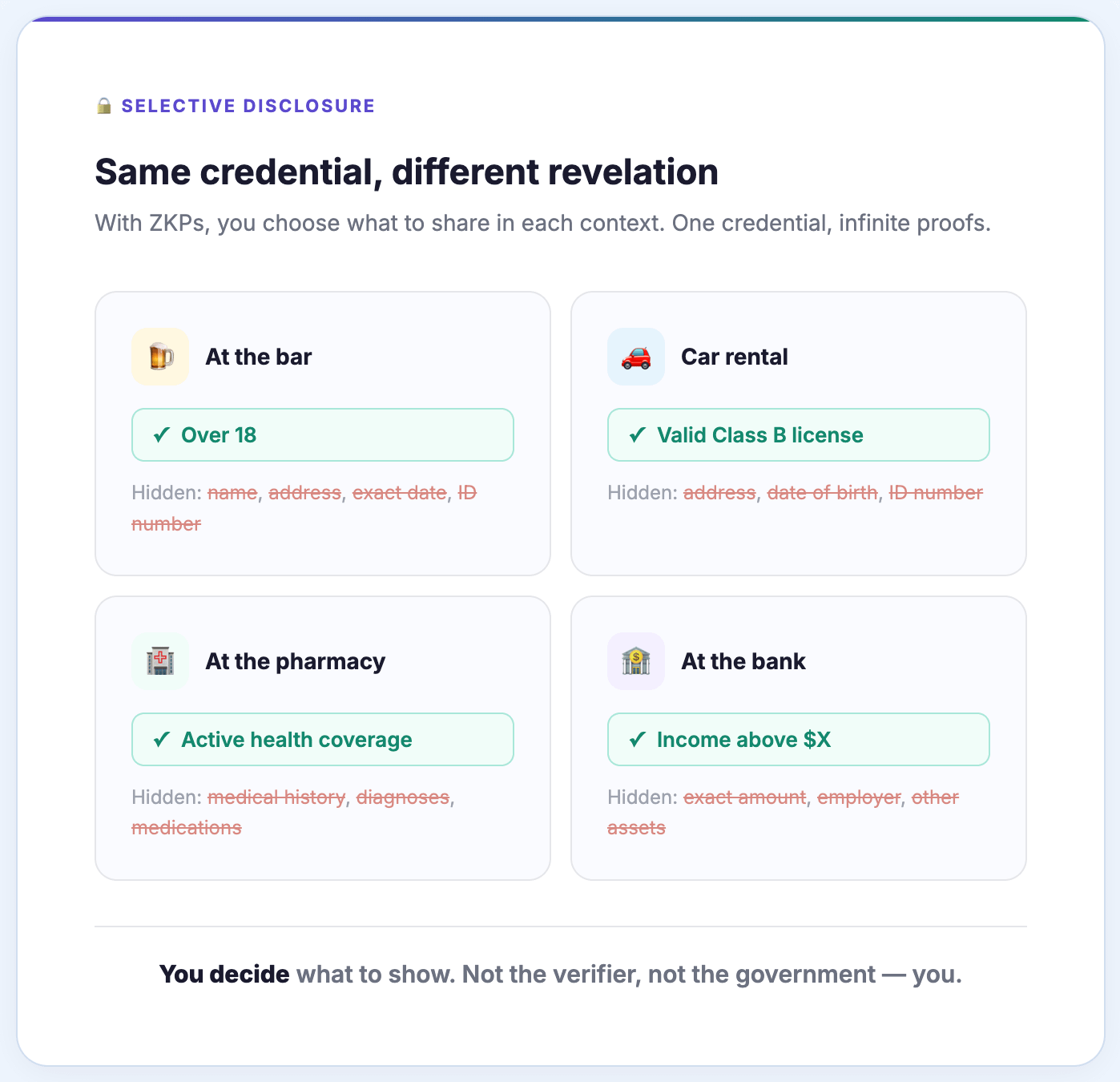
Same credential, different contexts, different information revealed. You decide what to show. Not the verifier, not the government, not the company — you.
This is what Self-Sovereign Identity means: your identity belongs to you, and you control what, when, and with whom you share.
The Trust Triangle
For ZKPs to work in the real world, they need an ecosystem. Cryptography alone isn’t enough — someone needs to issue the credential, someone needs to store it, and someone needs to verify it.
This ecosystem is called the Trust Triangle, and it has three actors:
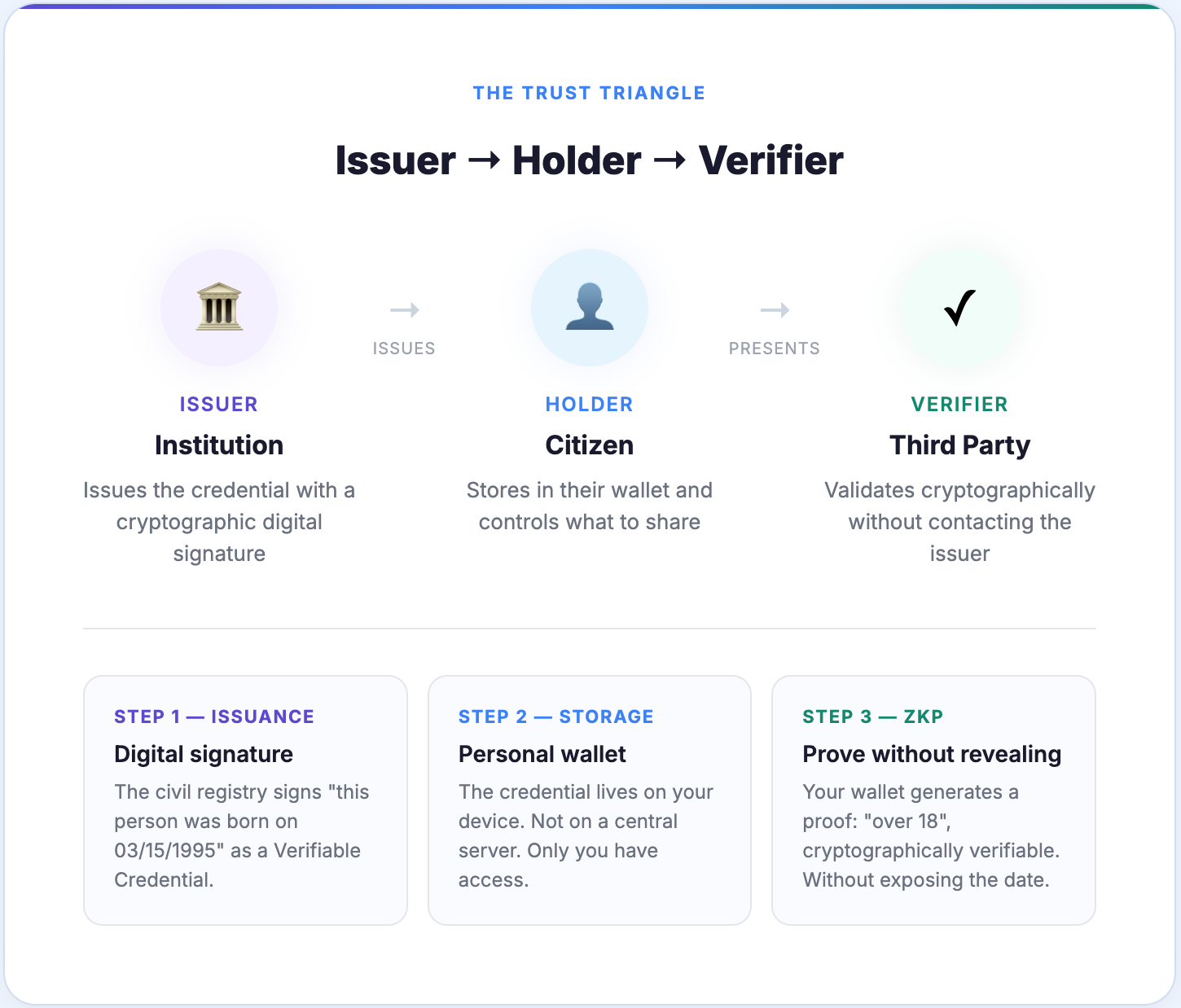
Here’s how the full flow works:
Step 1 — Issuance. A trusted authority (say, your country’s civil registry) issues a Verifiable Credential stating “this person was born on March 15, 1995.” It digitally signs the document to guarantee its authenticity.
Step 2 — Storage. You receive that credential in your digital wallet — an app on your phone. The credential lives on your device, not on a central server. Nobody else has access.
Step 3 — Verification with ZKP. The bar asks: “Are you over 18?” Your wallet generates a Zero-Knowledge Proof that says: “Yes, the credential signed by the civil registry confirms this person is over 18.” The bar can cryptographically verify this is true — without seeing your date of birth, without contacting the civil registry, without storing anything.
“Trust should be a protocol, not a product.”
The key point: the verifier doesn’t need to trust you. They trust the math and the issuer’s digital signature. Trust becomes verifiable, portable, and private.
Why Does It Matter? Beyond the Bar
The bar scene is illustrative, but real-world applications go much further. Think of every moment you’re asked to “prove something” by handing over excessive information:
University degree verification. An employer verifies you hold a degree without accessing your complete academic transcript, grades, or failed courses.
Border control. You prove your nationality and that your visa is valid without the agent seeing your entire travel history.
Medical prescription. The pharmacy verifies you have a valid prescription without accessing your diagnosis or medical history.
Social benefits. The government verifies you meet the requirements of a welfare program without exposing your entire financial situation to a bureaucrat.
In every one of these cases, the current model works backwards: to verify one piece of data, it demands you hand over twenty. ZKPs flip that equation.
The Problem with Centralized Databases
Every time an institution collects your information “to verify something,” that information gets stored in a database. And every database is a target.
According to IBM, the average global cost of a data breach in 2024 was $4.88 million. With ZKPs and verifiable credentials, the verifier never stores your data because they never receive it.
You can’t leak what you don’t have.
This Is Already Working
Everything above isn’t theory. This system is already in production, with over 8 million citizens in Latin America using verifiable credentials.
The stack that makes it possible implements every part of the Trust Triangle:
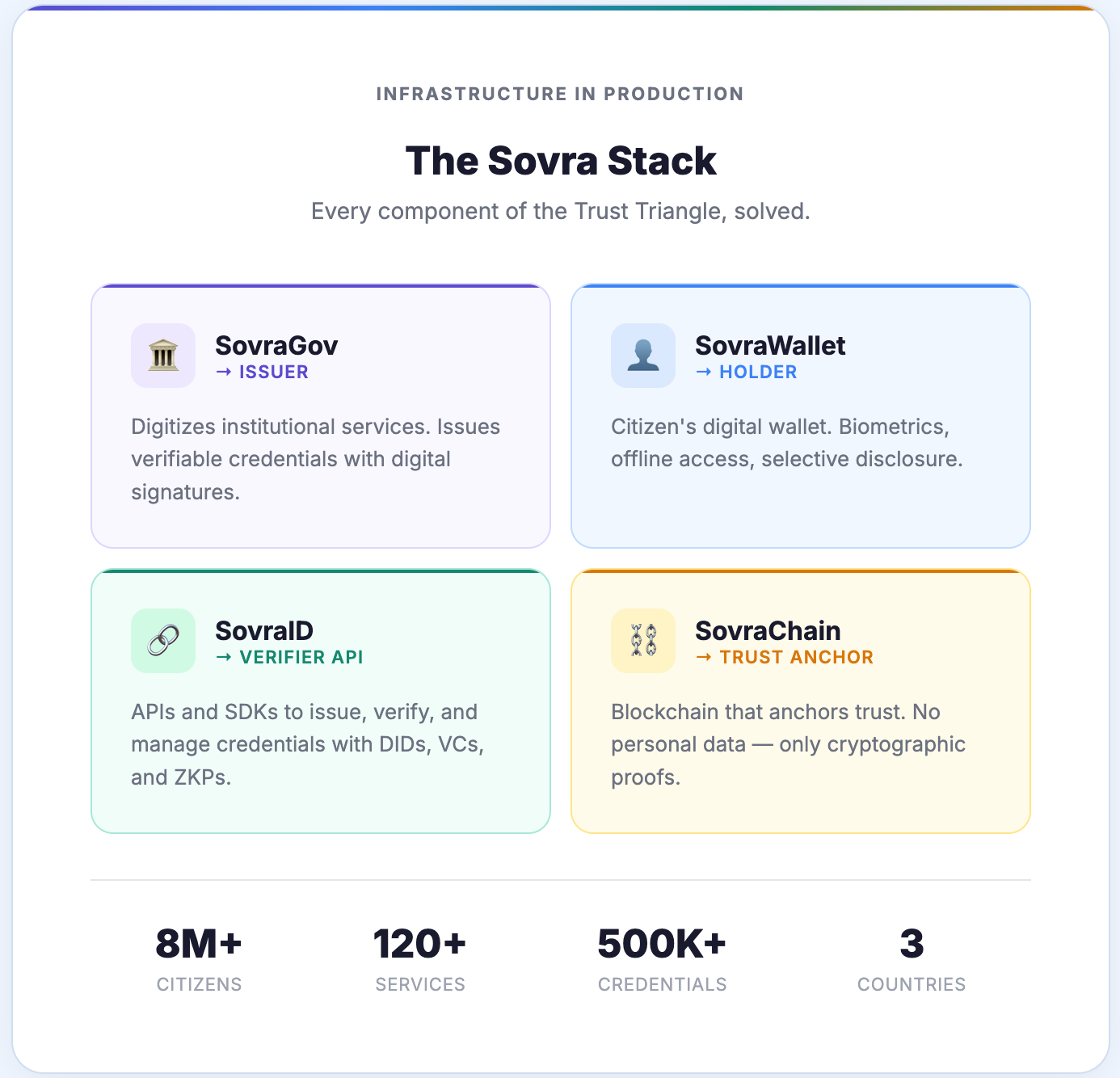
SovraGov (the Issuer) digitizes public institution services, enabling them to issue verifiable credentials — licenses, certificates, permits — with digital signatures.
SovraWallet (the Holder) is the digital wallet where each citizen stores their credentials, with biometric protection, offline access, and selective disclosure.
SovraID (the Verification API) provides the SDKs and APIs that let any application issue, verify, and manage credentials using DIDs, VCs, and ZKPs.
SovraChain (the Trust Anchor) is the blockchain that anchors trust cryptographically. It stores no personal data — only the mathematical proofs that a credential is valid.
The result: in Nuevo León (Mexico), over 120 government services already run on verifiable credentials. In Salta (Argentina), more than 500,000 credentials have been issued. Citizens control their data and verifiers validate without intermediaries.
The Next Time Someone Asks for Your ID
The next time a stranger asks for your driver’s license, your national ID, or your certificate of something, think about how absurd the current system is: you reveal everything to prove one single thing.
Zero-Knowledge Proofs aren’t a futuristic concept. They’re math that already exists, integrated into infrastructure that already works, serving millions of people who already control their own data.
The future of digital identity isn’t about institutions knowing more about you. It’s about them being able to trust you without needing to know everything.
“The most trustworthy system never needed your data in the first place.”
To dive deeper into the technology behind verifiable credentials, Sovra’s Knowledge Base covers Self-Sovereign Identity and Blockchain in depth. And to experience it firsthand, the interactive demo takes just 5 minutes.