



Peru now issues its national ID, the DNI, as a verifiable credential: a digitally signed version of the ID that lives in a phone wallet called Peru Pass, and that anyone can check without contacting the office that issued it. According to Biometric Update, the wallet went live on Android with 63 million credentials across the national ID, birth certificates and marriage certificates.
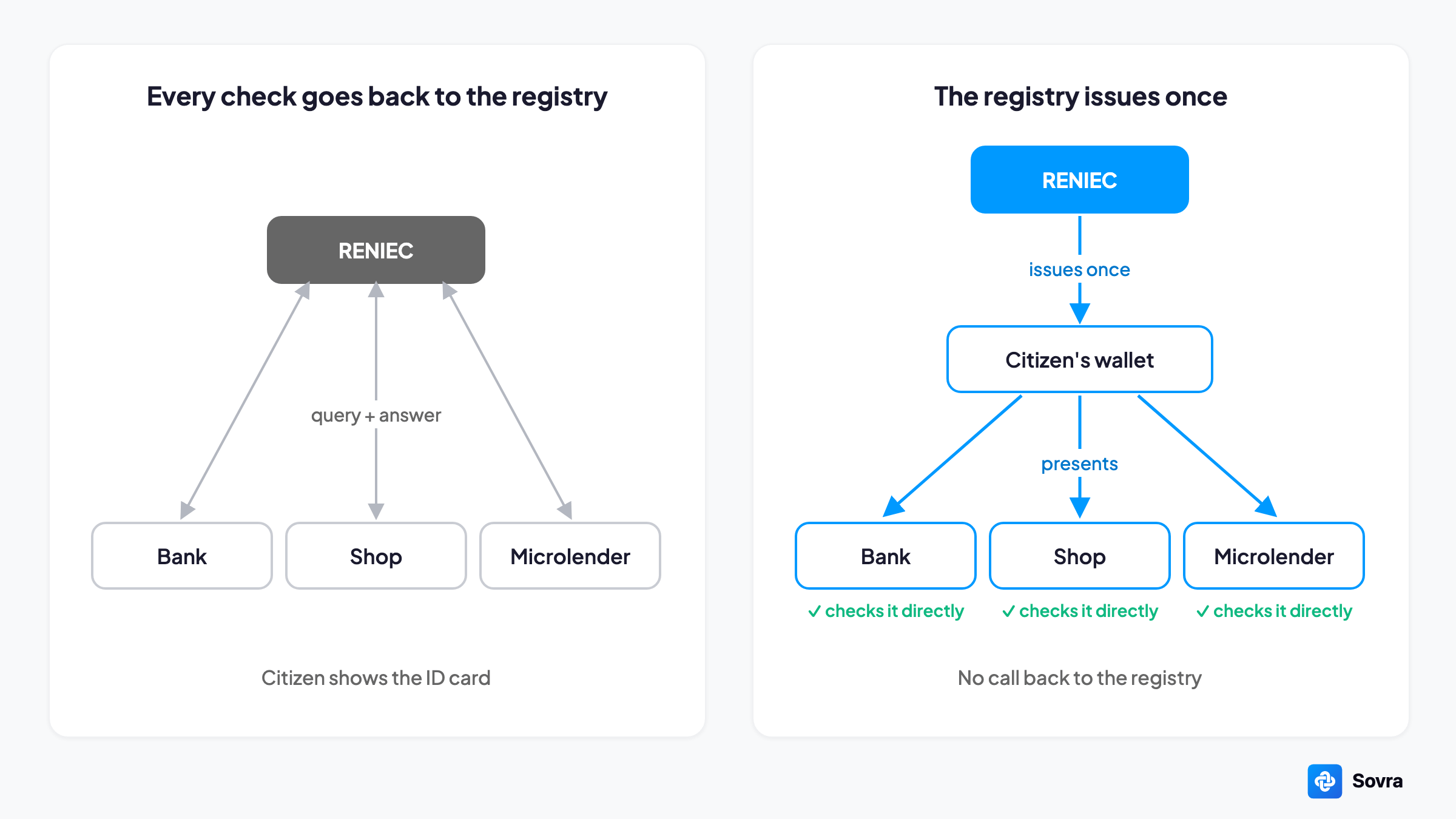
The decision that shapes the whole project is something RENIEC, Peru’s national registry of identity and civil status, chose to stop doing. Until now, a bank that received a customer’s ID card queried the registry to confirm it. With the digital ID, the bank checks the credential itself and the registry never learns the ID was shown, which gives the digital document the same privacy a plastic card always had.
In this episode of Sovra Podcast, Lucas Jolías speaks with Héctor Saravia, Director of Certification and Digital Services at RENIEC. Héctor spent years in the private sector as a would-be user of Peru’s electronic ID before joining the registry in 2023, which gives him an unusual view of the problem: he knows what a bank needs from an ID because he used to be the one asking for it. The conversation covers where the project came from, the international partners who made it possible, and the design decision at its center.
What You Will Hear
1. Why a chip in the card was never enough Peru has had an electronic ID with a cryptographic chip since 2013, and few people used it. Héctor explains why: the conventional card kept being issued and was cheaper, and the public and private sectors never received the components to read the chip directly. So every bank that received a customer’s ID still queried RENIEC to confirm the person was who the card said. A registry that answers every check becomes the center of every transaction, and Héctor describes how that pattern left copies of citizens’ data spread across companies, most of it out of date.
2. Looking east, and a meeting in El Salvador At the start of 2024 the team studied the credential model behind US mobile driver’s licenses, then turned to Europe’s eIDAS 2 framework and to India. Peru’s new personal data protection rules were also narrowing how registry data could be supplied. The budget did not cover a new build. The turning point came at a digital identity event in El Salvador, where Héctor heard Manuel Aguilera of the Centre for Digital Public Infrastructure (CDPI) explain how CDPI helps countries implement digital public infrastructure with verifiable credentials, a story Manuel told from his side in our conversation with Manuel Aguilera of CDPI.
3. The design decision: verification does not go through RENIEC This is the idea Lucas singles out and the one Héctor calls the part the team loved from the beginning. RENIEC issues the credential, and the proof travels inside it, so a shop or a bank can confirm the ID is authentic and current without asking the registry. Héctor’s phrase for it is that RENIEC becomes “blind and deaf” to each presentation. It restores the privacy of the physical card, where the registry never learned that you showed your ID to buy a bottle of wine, and it lines up with the consent principle in Peru’s data protection law. We walked through the mechanics of verification that never calls the issuer in an earlier edition, which explains how a verifier checks the signature and the credential’s status on its own.
4. Open source, a pilot, and a partner network RENIEC’s first contact was with MOSIP, the open-source identity platform, and the pilot ran on Inji, MOSIP’s open-source credential stack. The team challenged the Inji side to use RENIEC’s existing authenticator instead of its own, which cut cost, and they made it work across time zones and a language gap. CDPI brought in Co-Develop and the philanthropic platform VélezReyes+ to fund and support the build. Héctor is candid that the eight months it took were mostly spent on RENIEC’s own security protocols, which is the kind of internal work that makes a platform fit to be treated as a critical service.
5. The burden of proof moves When the registry stops answering every query, the evidence of a verification lives with the verifier and in the citizen’s wallet. Héctor admits this is the hardest idea to teach: RENIEC runs bootcamps for verifiers, and businesses ask what their new responsibilities are. The answer he gives them is a model with lower costs. A friend in the financial sector told him that identifying customers this way could cut his recurring verification costs by at least 80%, because the work becomes a one-time integration. Updates change shape too: when a citizen moves house or marries, RENIEC can revoke the old credential and issue a new one instead of printing a new card, a pattern we explain in how revocation works.
6. Sustainability through verifiers RENIEC’s traditional income comes from charging for queries, so a design that removes queries forces a new plan. Héctor’s plan is to grow the number of verifiers: a trust list of registered verifiers that citizens can recognize, faster transactions for the businesses on it, and an open call so private technology companies can bring the verification components to their own clients under the same technical documentation and standards. Phase two, with support from the Inter-American Development Bank, is meant to take the platform from a first version that covers the basics to a second one.
Key Quotes
“We loved the idea that we would be blind and deaf every time a digital ID is presented. That’s what would really create a system of trust, because nobody is getting in between my verifier and me.”
“Now the burden of proof is no longer going to be on RENIEC. It’s going to be on the verifier itself and on the citizen’s wallet.”
“The digital ID is the solution. We’ll do facial biometrics. And we went to the rainforest and it worked.”
“Let’s lose our fear of open source. It can give you a bit more sovereignty as a country too.”
About the guest
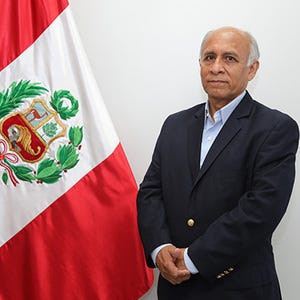
Héctor Saravia is Director of Certification and Digital Services at RENIEC, the Registro Nacional de Identificación y Estado Civil, which runs Peru’s national identity, civil registry and electoral roll. He was appointed in February 2023 after a long career in the private sector, where he worked with clients who wanted to build on Peru’s electronic ID. His directorate led the DNI digital project and Peru Pass, working with MOSIP, CDPI, Co-Develop and VélezReyes+. His perspective is valuable because he has sat on both sides of the counter: he knows what a business needs from an identity document, and he now runs the part of the state that issues it.
More from Sovra
🎧 [PODCAST] Ep. 9: Latin America Has Everything to Win at Digital Infrastructure (with Manuel Aguilera) · the CDPI side of this story: how Brazil and India built shared rails, and why the region can reuse them instead of building alone.
🎧 [PODCAST] Ep. 10: The Provinces Are Not Waiting (with Mauro Solano) · how Argentina’s 24 jurisdictions coordinate a digital agenda, and why reuse makes infrastructure affordable.
📖 Privacy Is Not a Trade-Off · how a verifier checks a credential without contacting the issuer, the property RENIEC built its design on.
📖 The full lifecycle of a verifiable credential · issuance, presentation, status and revocation, the steps behind Héctor’s address-change example.
Continue the conversation
Explore the standards and building blocks behind these ideas at sovra.io/knowledge, our hub for digital identity and verifiable credentials. Sovra builds this layer for governments: SovraID for issuing and verifying credentials, SovraWallet for the citizen side, and SovraGov for the services built on top. Across deployments, that stack already serves 8M+ citizens with 1.5M+ identities across 20+ governments.
We read every response, so reply and tell us how verification works in your country today: does every check still go back to the registry? Forward this to someone working on identity in a civil registry or a bank.
Subscribe to The Identity Brief, published every week.
🎧 Listen to the full episode on YouTube