




A week ago, we published Propia, a public trust layer for verifiable digital credentials, and explained why we are building it as open infrastructure.
In short: institutions verify the same facts over and over. Verifiable credentials make those verifications reusable, but for that to work, a verifier needs to know who is authorized to issue a credential, which keys control that identifier, and whether the credential is still valid.
Propia provides that trust layer through public, independently verifiable registries.
To see how it works, let’s follow one situation from beginning to end: someone walks up to a rental car counter and presents a digital driver’s license on their phone.
What can the counter verify?
The verifier checks five things:
Integrity. The signed credential has not been modified.
Issuer authority. The signing key belongs to an issuer authorized to issue that type of credential under the relevant trust framework.
Holder binding. The person presenting the credential satisfies the binding method defined by the credential.
Temporal validity. The credential is within its defined validity period.
Status. The credential has not been suspended or revoked.
A digital signature proves that a particular key signed the credential. But that alone does not establish whether the key was authorized to issue a driver’s license, whether it is still the key recognized for that institution, or whether the license remains valid.
Those are the questions answered by Propia’s three public registries.
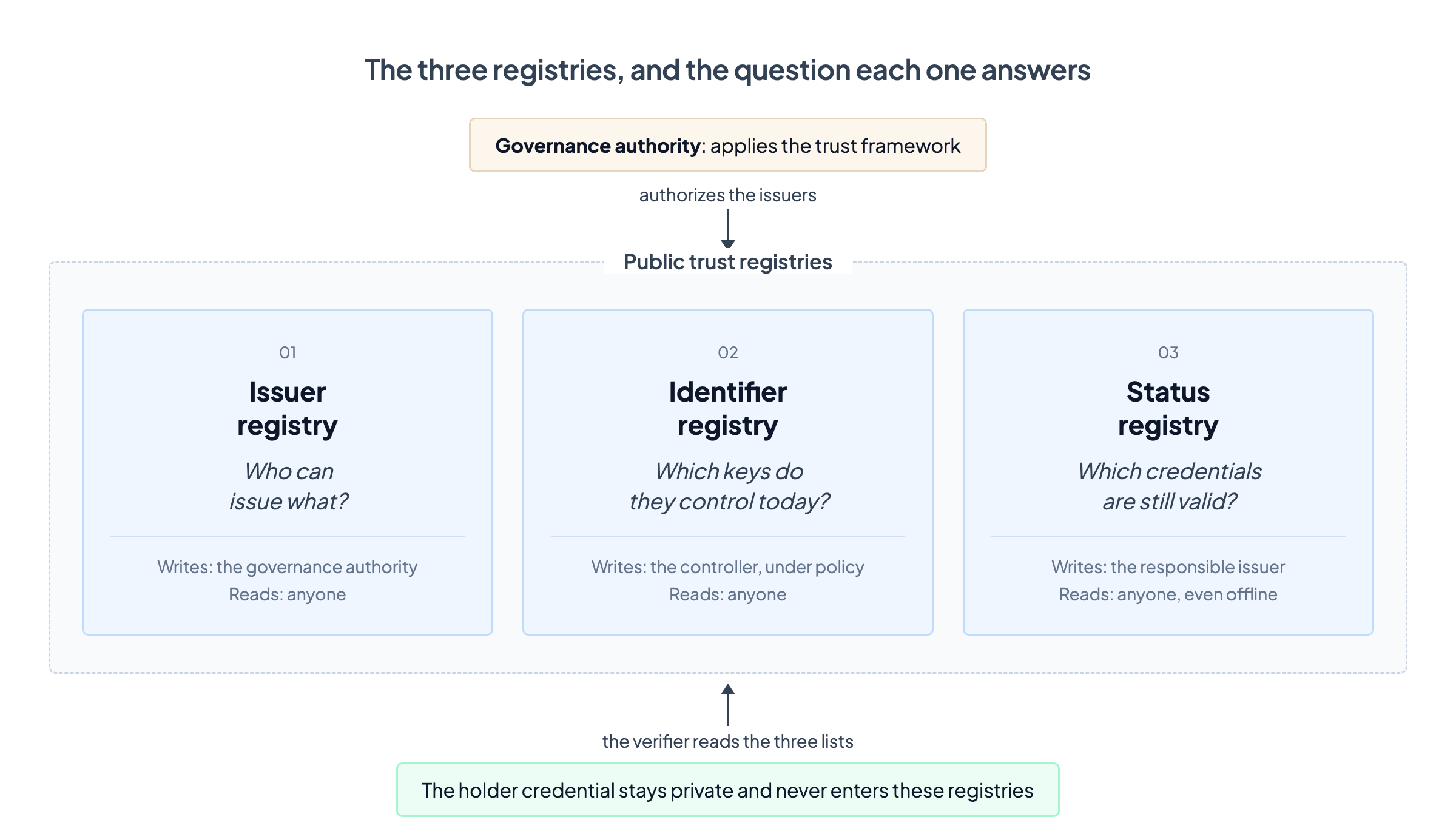
1. Issuer Registry: who can issue what
The first registry answers a basic question: who is authorized to issue a particular credential, and within what scope?
A transport authority may be authorized to issue driver’s licenses in one jurisdiction without being authorized to issue university degrees or licenses elsewhere.
That authorization comes from the relevant trust framework: the legal, policy, governance, and operational rules under which institutions issue and accept credentials.
Propia records that authorization so it can be independently verified.
The governance authority controls who can update issuer authorizations. This matters because permissionless self-registration would only prove that an entity controls a cryptographic key. It would not establish the institutional authority required to issue a regulated credential.
Reading the registry remains open, and changes to authorization state are auditable.
2. Identifier Registry: who controls the keys
An institution may change its keys without invalidating credentials it has already issued.
Devices are replaced, responsible staff change, and identifiers may need to be recovered. Credentials, meanwhile, can remain valid for years.
The Identifier Registry records the information needed to manage that continuity: current verification methods, who controls an identifier, and the rules under which that control can change.
Key rotation and recovery therefore become explicit, verifiable state transitions.
This also affects credential continuity. A credential bound to a stable identifier may remain usable after an authorized key update. A credential bound directly to a device key may require re-issuance.
Propia does not require a proprietary identifier format. Credential profiles may use W3C DIDs or another compatible identifier scheme, provided that control state and authorized changes can be independently resolved and verified.
3. Status Registry: what remains valid
A driver’s license can be valid today and suspended or revoked tomorrow.
The Status Registry allows issuers to publish that change in a compact form. Verifiers can check current status without making a private callback to the issuer every time a credential is presented.
This also supports scenarios with limited connectivity. Status can be cached, provided there is an explicit policy defining how long that information remains trustworthy.
Just as importantly, the registry records the credential’s status, not where or when the credential was presented.
The same logic, across institutions

The rental car example is only one case.
A government may issue a foundational identity credential. A university can verify it and issue a diploma. A professional body can verify both before issuing a license. An employer, bank, or public agency can then verify the credentials it needs.
The institutions do not need access to each other’s databases. Each verifies a standardized presentation, applies its own legal and administrative rules, and may issue another credential.
This is where composability comes in: the signed output of one institutional process can become a verifiable input to another.
Instead of starting from zero, an institution can build on a verification that another institution has already performed.
This reduces repeated verification, document handling, fraud review, and bilateral integrations. It also allows new wallets, verification services, and applications to participate without relying on a central operator.
What stays outside Propia
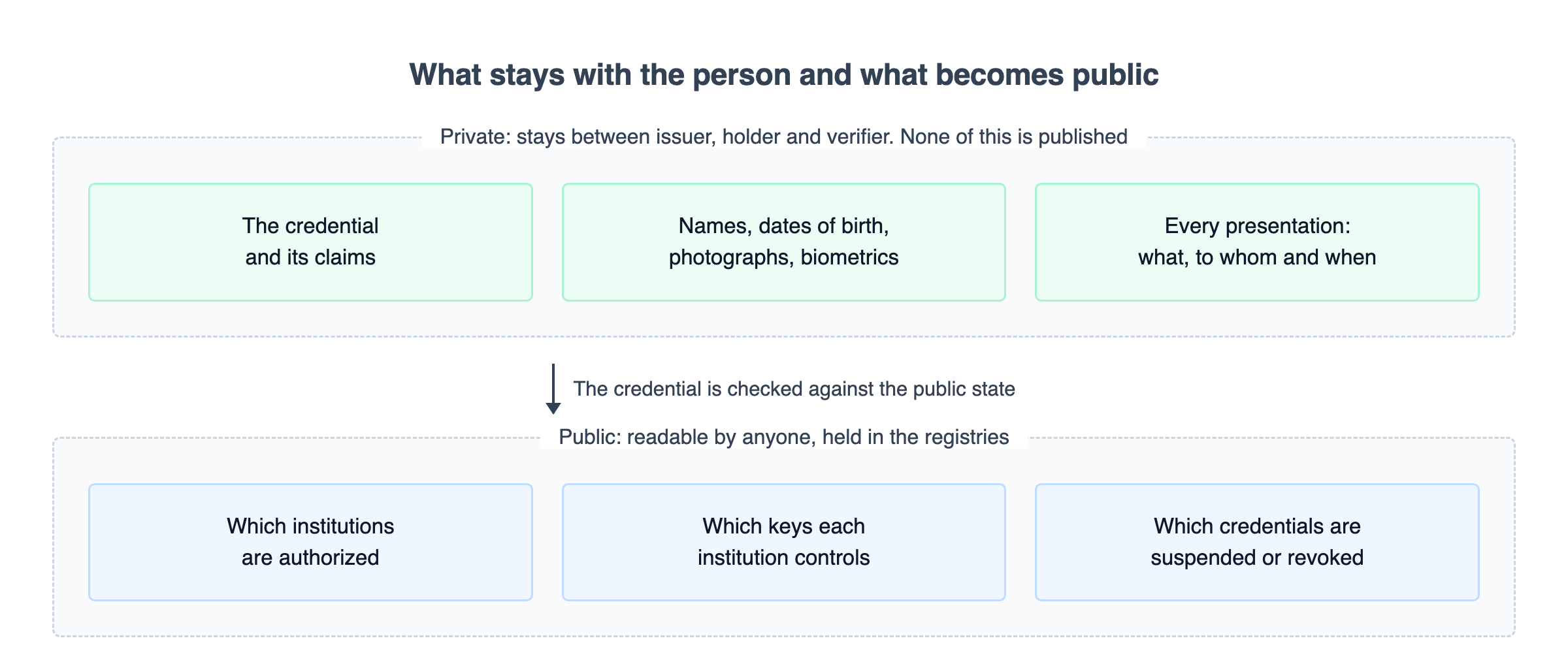
For this infrastructure to remain public, it also matters what is not made public.
Credential payloads, claims, and personal data remain under the holder’s control. Propia’s public registries do not contain names, addresses, dates of birth, photographs, document numbers, or biometrics.
They also do not record presentation requests, responses, or usage histories.
What becomes public is the information different verifiers need to establish trust: issuer authorizations, identifier control, and credential status.
This allows independent participants to verify against the same accepted trust state without routing every presentation through an issuer’s server or a central operator.
Why public infrastructure?
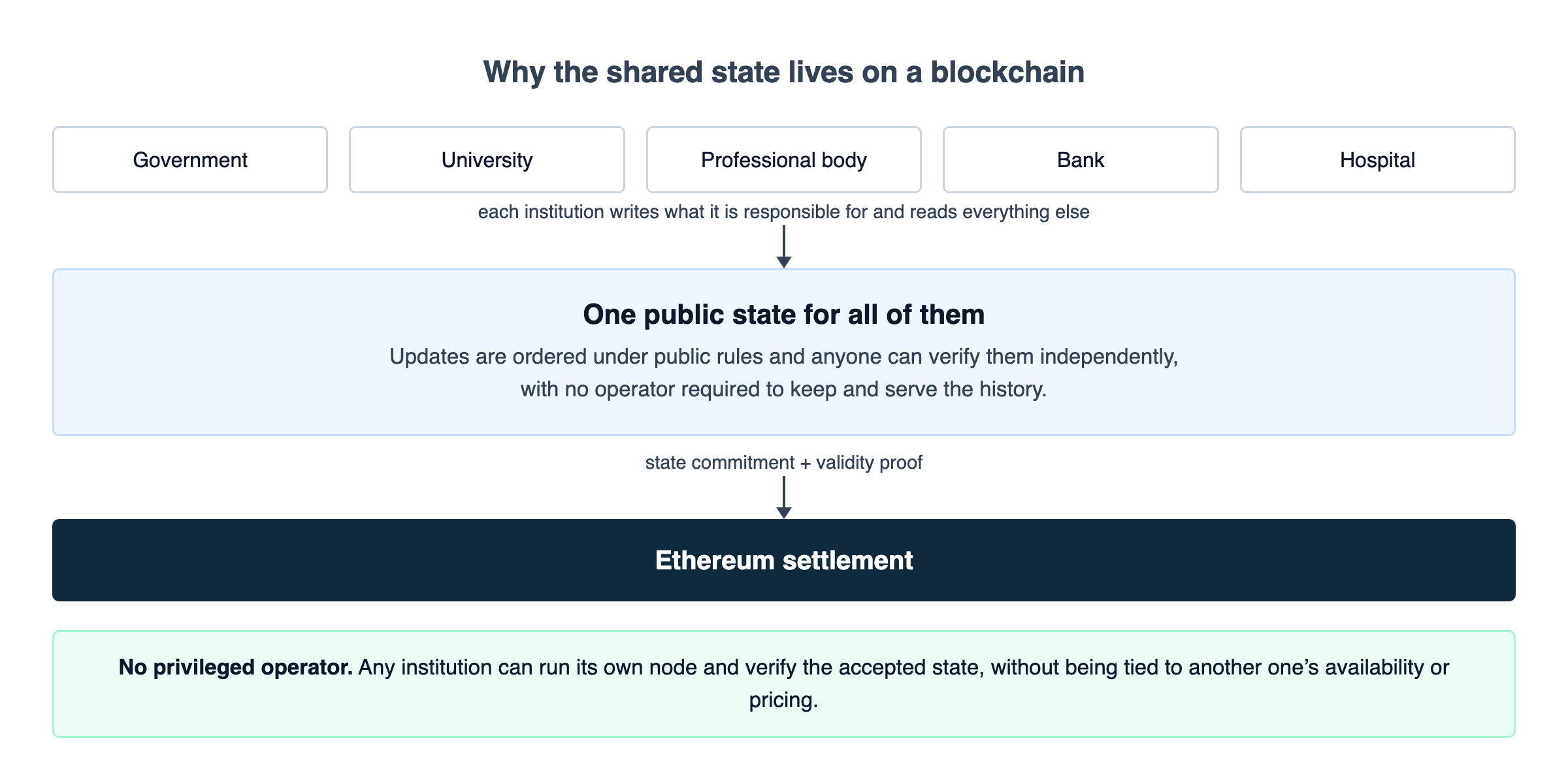
These registries could simply be implemented as a database operated by a single provider. That would create a common interface, but the provider would control availability, update ordering, and retained history.
Propia uses blockchain to avoid that dependency on a privileged operator.
Ethereum serves as the settlement layer, recording accepted state commitments and allowing the resulting state and its governing rules to be independently verified.
For population-scale operation, Propia proposes an Ethereum Layer 2 validium, where many operations can be executed and batched before settlement on Ethereum. Validity proofs allow Ethereum to verify that those state transitions follow the protocol rules.
The data required to reconstruct the Layer 2 state remains outside Ethereum. This reduces the cost of publishing large amounts of data, while making data availability an explicit responsibility of each deployment.
Blockchain does not create institutional authority. A government remains responsible for deciding who may issue a national identity credential, and a university remains responsible for its degrees.
Propia represents that trust state. It does not create it.
The objective
The objective is not to put identity on a blockchain.
It is to separate two things that are often coupled today: the private data contained in a credential and the public state required to verify that credential.
Open credential standards make credentials portable across systems. Propia adds the public trust layer needed to independently verify issuer authority, identifier control, and credential status.
A credential issued after one institution completes a verification process can then become a reusable input to another institution’s process.
The goal is simple: institutions should be able to build on prior verification instead of starting from zero.
Further reading
The Propia whitepaper: the complete protocol specification.
The Full Lifecycle of a Verifiable Credential: from issuance to revocation.
How the Mobile Driver’s License Works: what happens behind a digital driver’s license.
W3C Verifiable Credentials Data Model 2.0: the credential standard underlying the model.
Keep the conversation going
If your institution is working on credential issuance, verification, or revocation, reply to this email and tell us where the difficult parts are.
Subscribe to The Identity Brief, published every week.