



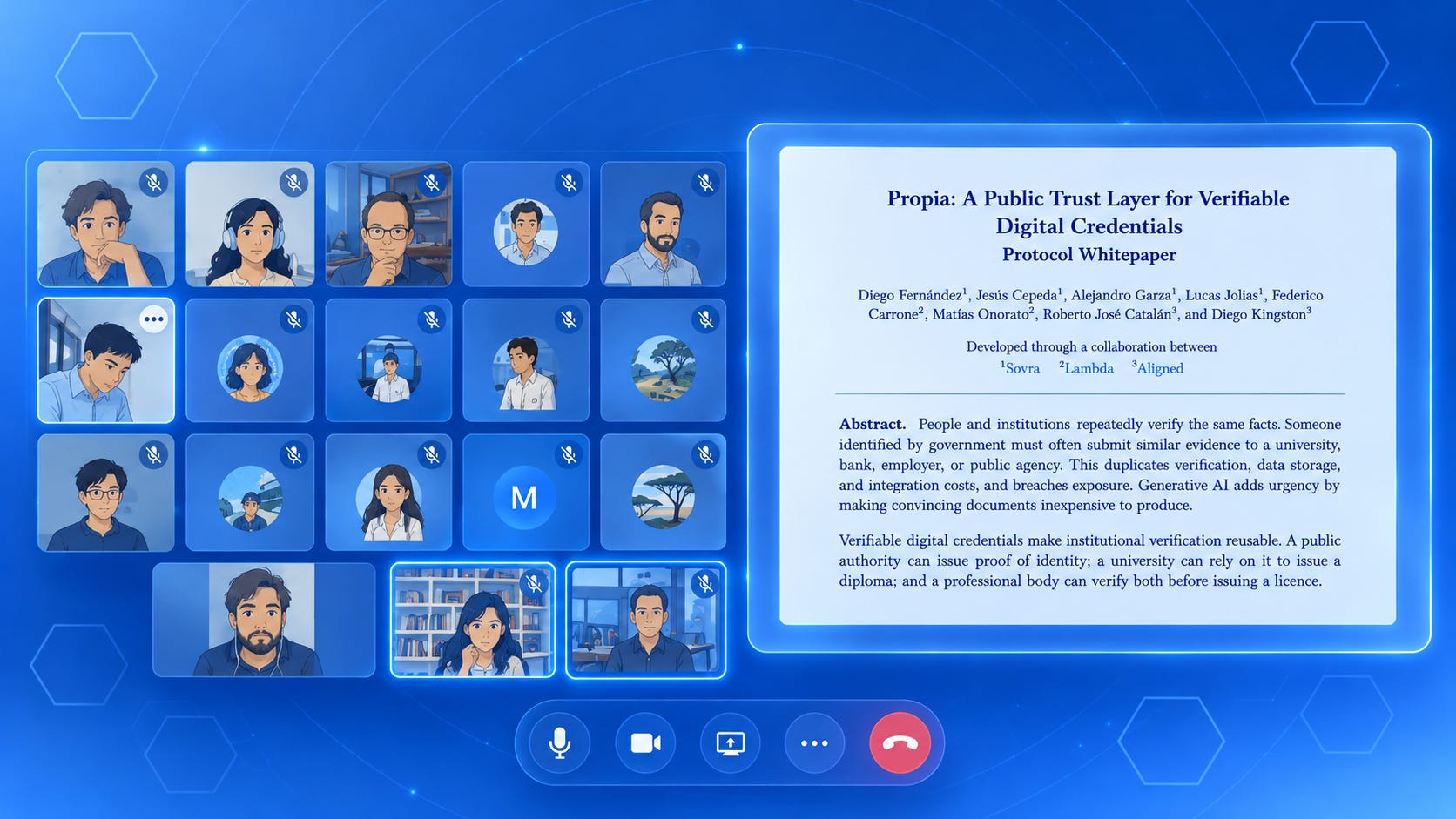
This week FederAI, the forum where Argentina’s 24 jurisdictions work on a shared digital transformation agenda, opened its Digital Identity working group, and we are coordinating the technical side. Provincial modernization teams now sit at one table with a concrete goal: a credential issued by one province is recognized in every other, while each jurisdiction keeps its own systems and its own autonomy.
Mauro Solano, who coordinates FederAI’s technical secretariat, explained how that forum works in Ep. 10 of Sovra Podcast: every jurisdiction owns the agenda as an equal, on a fifteen-day working rhythm.
At the first session, Lucas Jolías and Diego Fernández presented Propia as the technical foundation. The provinces are now designing the governance that will run it, and the first interprovincial case is already on the table.
The protocol on the table

Propia is an open protocol for verifiable digital credentials, built on W3C standards, which we wrote together with LambdaClass and Aligned and published as a whitepaper. A verifiable credential is a document signed by an institution (a license, a degree, a professional registration) that the person carries on their phone and that anyone can check cryptographically.
Propia separates two things. The credential and the personal data travel privately between the issuer, the holder and the verifier. What the verifier needs in order to trust that credential lives in public registries that any institution can read: who may issue what, which keys each issuer controls, and which credentials are no longer valid.
That separation is what lets each province keep its own issuance systems. Nothing in the protocol asks a jurisdiction to replace its software or share its databases. What it shares is the public state that makes its credentials verifiable from any other.
How credentials are verified across provinces
Imagine a driver’s license issued in Córdoba and presented to an authority in another province. With Propia, that authority can verify the license without contacting the organization that issued it. The verification involves four checks:
The signature: confirming that the credential’s contents have not been altered since it was issued.
The key: confirming that the signature corresponds to one of the issuer’s public keys, based on the registry and its key rotation history.
The authority: confirming that the organization is authorized to issue that type of license under the rules agreed upon by the provinces.
The status: confirming that the license has not been suspended or revoked, using the public status list.
Verification requires neither a call to the issuer nor an integration between the two provinces’ systems. With 24 jurisdictions, pairwise integrations would mean 276 bilateral connections to build and maintain. With a shared registry, each jurisdiction publishes once and the others can consult the same information. We explain each registry in detail in The Three Registries of Propia.
What governance needs to decide
The protocol defines how verification works. The working group decides the rules behind those checks, and that is the work currently underway.
Who can issue credentials. Writing to the issuer registry requires a governance authority. The provinces must jointly define which organizations can issue which types of credentials and how new issuers are approved. This agreed onboarding process gives verifiers in other provinces a reason to trust an issuer’s authority, beyond simply confirming that it controls a key.
How credentials are revoked. The group defines who can change a credential’s status, the difference between a suspension and a revocation, and how quickly a change must be published so that other provinces see it during their next verification.
Auditability. Every change to the registries is recorded and can be audited by any member.
Credential schemas. For a license issued in one province to be understood in another, both need to agree on a common format for that type of credential. Interprovincial driver’s licenses are the first use case where the group will define that format.
The group has chosen to agree on these rules before writing software. Once governance is in place, each jurisdiction can keep its existing systems while credentials travel with their holders.
What remains open
The governance model, the credential schema, and the onboarding rules for the first use case are still being discussed by the provinces. The technical protocol is already available in the whitepaper, so any jurisdiction can review it before the rules are finalized.
Thanks to FederAI, Mauro Solano, Magdalena Crisconio, Santiago Festa, and every provincial team that has joined the working group.
Worth reading this week
Propia whitepaper: the full architecture, with the three registries and the separation between private exchange and public state.
El camino hacia un federalismo inteligente (Infobae, Mauro Solano, in Spanish): the case for FederAI as a space for federal coordination.
How a Country Verifies an Identity Issued by Another: the checks a government runs before accepting a foreign credential, the same question at national scale.
Continue the conversation
Our knowledge hub at sovra.io/knowledge explains DIDs, verifiable credentials and status lists in plain language.
If you work on identity in a provincial or national government, reply to this email and tell us which credential you would make interjurisdictional next. We read every response, and if a colleague works on interoperability, forward this edition to them.
Subscribe to The Identity Brief, published weekly.